


Cutting LiDAR will save money, but can a camera vision-only system handle Hanoi’s chaotic traffic system? By Stewart Burnett
Vietnamese electric vehicle (EV) maker VinFast has partnered with AI firm Autobrains to develop low-cost self-driving technology using cameras rather than expensive sensor arrays. The companies announced on 26 January that they will pursue a “Robo-Car” architecture that eschews LiDAR sensors, radar systems and high-definition mapping in favour of a Tesla-style approach relying on seven standard cameras and a compact computing chip.
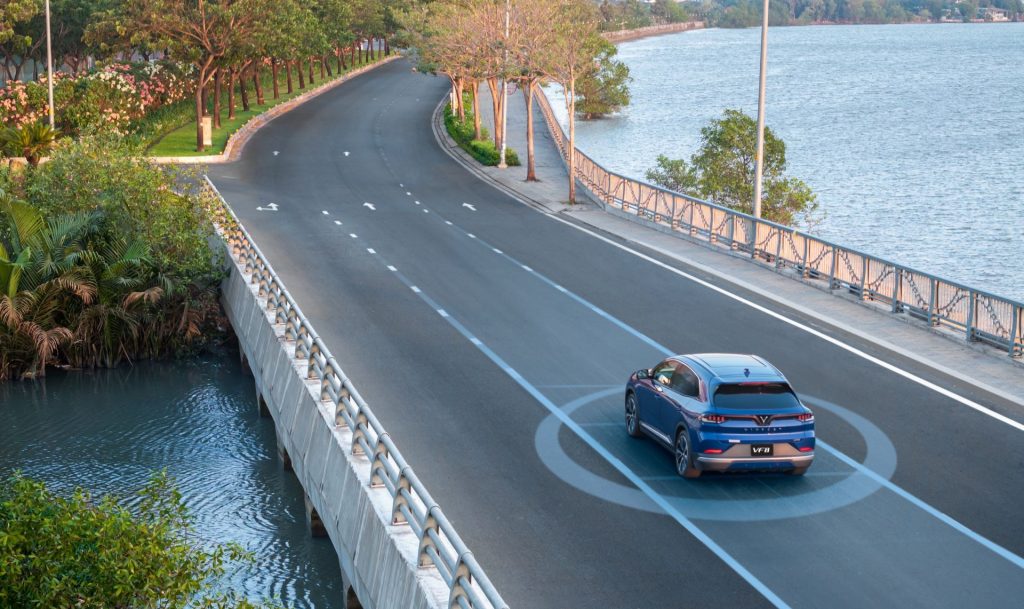
The collaboration will focus initially on enhancing VinFast’s existing SAE Level 2 advanced driver assistance system capabilities across its existing lineup. Pilot testing of upgraded features is already underway on the VF8 and VF9 models in controlled zones throughout Hanoi, with plans to gradually expand trials to larger Vietnamese cities and international markets where VinFast operates.
VinFast’s decision to pursue camera vision-only—still a contentious subject among autonomous driving experts—constitutes a pragmatic pivot towards cost reduction and faster deployment that matches the automaker’s focus on affordability and quick scalability. By stripping out hardware components that can cost tens of thousands of dollars per vehicle, the automaker hopes to make AV features viable for mass-market electric vehicles rather than premium models alone.
The camera-based system may face substantial technical hurdles in Hanoi’s traffic environment, which operates fundamentally differently from the more structured and orderly road systems where most autonomous driving technology is trained. While, for example, US autonomous vehicles typically track at most a few dozen large, predictable objects like cars and trucks, systems deployed in Hanoi must simultaneously process hundreds of motorbikes moving in non-linear patterns through gaps that constantly shift.
Hanoi traffic also relies on negotiated merging where drivers edge forward slowly while others flow around them, a dynamic that would likely cause Western-trained self-driving systems to remain permanently stopped at busy intersections. In these circumstances, spatial awareness and intuition replaces the lane discipline and signal coordination that autonomous vehicles depend upon in other markets.
VinFast’s partnership with Autobrains—and its decision to train specifically in Hanoi—suggests the automaker recognises that achieving functional autonomy in chaotic traffic conditions cannot be achieved by transplanting technology validated in existing markets. Whether camera vision and compact processing systems can achieve the predictive accuracy needed to handle Hanoi’s fluid, intuition-based traffic remains an open question that testing in controlled zones has yet to answer.
Autonomous Driving,E-Mobility,Markets,News,OEMs,Software-Defined Vehicle,Stewart BurnettStewart Burnett#VinFast #teams #Autobrains #lowcost #autonomy #push1769513169

More Stories
Pony.ai, CATL partner on first L4 electric light truck
UK lays regulations for automated passenger services
Leapmotor reveals China-only B05 Ultra at Beijing show