



Japanese players continue to struggle against Chinese entrants in Thailand, while Ford sees an opportunity to strengthen its position. By Stewart Burnett
Suzuki has agreed to sell its Thai assembly plant to Ford, marking the Japanese automaker’s total withdrawal from production in the Southeast Asian nation following several years of dwindling output. The transaction covers Suzuki’s entire 66-hectare facility in Rayong, which will be transferred over to Ford for US$3.9bn paid out over 30 years.
Suzuki’s exit comes on the heels of a catastrophic decline in manufacturing volumes at the site, which opened back in 2012 with an initial investment of JP¥20bn (US$126m) and ambitions of fully utilising the 80,000-unit annual capacity. Production peaked at nearly 60,000 vehicles annually but plunged to just 4,400 units in 2024, leaving the facility operating at roughly 5% of its intended capacity. In a statement to Nikkei, a Suzuki spokesperson attributed the Thai production exit to the failure of small cars to gain anticipated market traction, exacerbated by currency pressures and shifting consumer preferences.
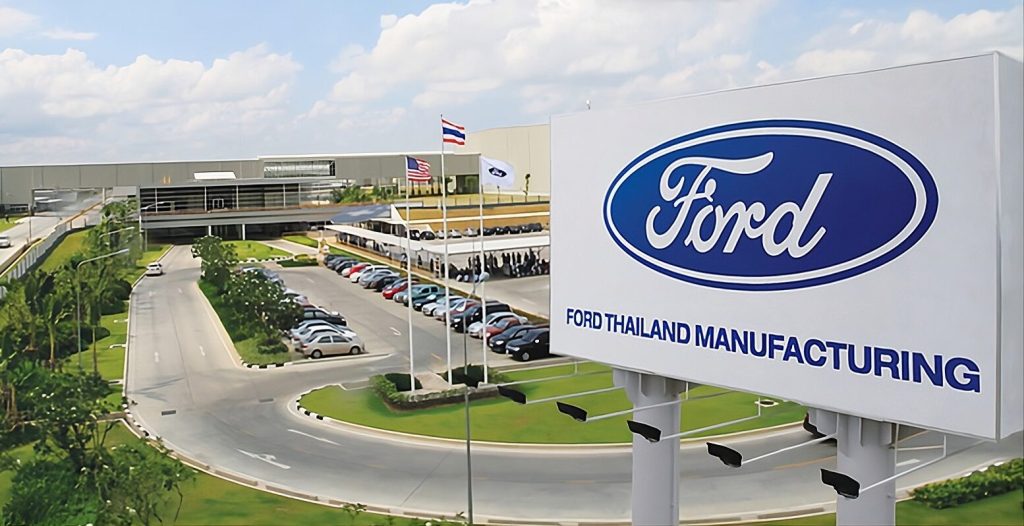
The acquisition grants Ford an additional 65,000 square metres of factory space directly adjacent to its existing Thai operations, where the automaker currently produces the Ranger pickup and Everest SUV for domestic and export markets. Before the latest expansion, Ford’s combined Thai facilities—including Ford Thailand Manufacturing and AutoAlliance—already exceeded 270,000 units of annual capacity. From this output, approximately 90% was exported to overseas markets across Southeast Asia, Oceania, and elsewhere.
The expansion reinforces Thailand’s position as Ford’s primary regional manufacturing hub, distinguishing the automaker as the sole US player to have a manufacturing presence in the country following General Motors’ exit in 2020. GM’s plant in Rayong was sold to Great Wall Motors, one of a growing number of Chinese OEMs to use Thailand as a global production hub.
Japanese automakers, once dominant in Thailand’s automotive industry, now find themselves on the retreat. As recently as 2020, Japanese brands accounted for roughly 90% of the country’s market share, but tumbled below 70% in the first 11 months of 2025 as Chinese entrants gain a foothold. Chinese brands including the aforementioned GWM, as well as BYD, Changan, MG and Chery have surged to 21% share during the same timeframe—quadruple their 2022 position.
This competitive pressure has forced multiple Japanese OEMs to consolidate their Thai operations. Honda, for example, has merged two assembly plants whilst Nissan and Mitsubishi have each idled facilities, with the latter planning to freeze one of three plants by mid-2027. Meanwhile, Ford’s focus on premium pickups and SUVs means it is largely insulated from the affordable segment where Chinese competitors have devastated Japanese small-car specialists like Suzuki.
E-Mobility,Manufacturing,Markets,News,OEMs,Ford Motor Company,Stewart Burnett,SuzukiFord Motor Company,Stewart Burnett,Suzuki#Ford #snaps #Suzuki #Thai #plant #Japan #retreat #continues1769520182
More Stories
Pony.ai, CATL partner on first L4 electric light truck
UK lays regulations for automated passenger services
Leapmotor reveals China-only B05 Ultra at Beijing show