



AI and software could reshape manufacturing, but companies may need a nudge to get the ball rolling. By Megan Lampinen
The digital revolution and increasingly sophisticated AI are reshaping automotive manufacturing. Greater use of factory 5G, sensors, and AI are producing vast amounts of data, which if harnessed correctly, could raise the bar further still. Both interest and investments in Industry 4.0 are growing, but innovation doesn’t come cheap, or easily.
Justifying investment
Smart factories are defined by real-time access to operational data across machines and systems, systems that can operate autonomously in some degree, and the ability to adapt to new products or volumes with minimal disruption. Research from Capgemini found that in 2024, about one-third of automotive plants had undergone a ‘smart transformation’ in the previous 18-24 months. As a result, more plants now have access to the sort of data they need to start making real changes.
“We have reached a point where software and data can be leveraged like they’ve never been leveraged before,” observes Craig Melrose, Global Managing Partner, Mobility and Advanced Technologies at digital engineering consultancy HTEC.
The key for automakers is to generate data that addresses the right problem. Is their focus on improving safety, reducing defects, or increasing renewable energy usage? “All of these are important, but how do you justify the investment if there’s not a financial value associated with it?” notes Melrose.
Gathering the data isn’t always straightforward for long-established companies. Despite the surge in smart factory investments, most automotive manufacturers still have legacy production infrastructure of varying ages, some of which might not be able to capture data. Doug Hockenbrocht, Partner in Plante Moran’s Information Technology Practice, tells Automotive World: “Manufacturers need real-time data to aid in decision making, but generally they have a collection of different generations of hardware in the plant. They are seeking integration, and they can only capture the data once they have achieved it.”
With the data collected and the use case confirmed, analytics then need to be applied, and this is where AI is increasingly being leveraged.
Real world impact
Audi has termed its future manufacturing vision the software-defined factory (SDF), a concept that roughly mirrors the software-defined vehicle (SDV) by decoupling control software from hardware to manage production processes more efficiently. The automaker expects that this could boost productivity by as much as 50%.
AI is at the heart of it. Gerd Walker, Audi’s Board Member for Production, has described AI as “a quantum leap for efficiency” in the company’s production network. As well as AI-controlled robots, Audi is deploying AI on the plant floor through its Edge 4 Cloud platform, embedding machine learning into production equipment for real-time decision-making that doesn’t depend on the cloud. The system processes data locally at individual workstations, theoretically allowing immediate quality adjustments and predictive maintenance while reducing latency.
At Nissan, one of the main focus areas has been improved energy consumption. “We’ve probably reduced energy consumption at Sunderland by 20% in last few years, purely by seeing the factory data and better managing things like powering down at the end of shifts and making sure lines run at exactly the right speed,” explains Andy Marsh, Vice President of Europe Engineering for Nissan. “It’s all about making data available, educating people, and giving them the tools they need.”
Smart factory innovation can come into play even before production begins. BMW harnessed Nvidia’s Omniverse platform to plan and validate its new plant in Debrecen, Hungary, through which it could build cars virtually well before any physical infrastructure was in place. Others are following suit. Nissan harnessed similar digital twin technology in preparation for the introduction of the latest Leaf model at Sunderland. “It’s taken months out of the development time,” adds Marsh. “When we installed the first physical equipment, it worked the first time.”
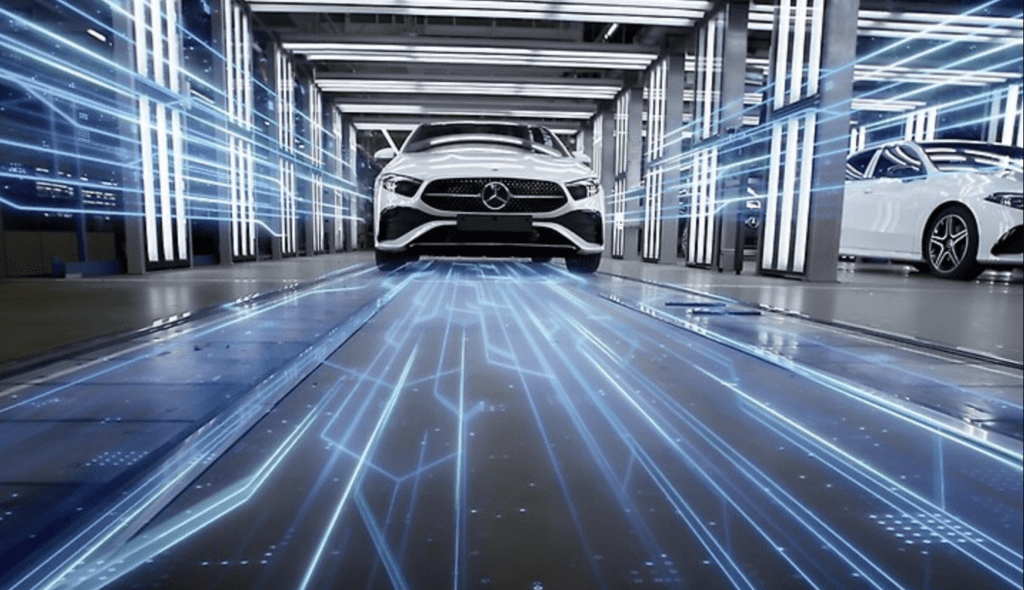
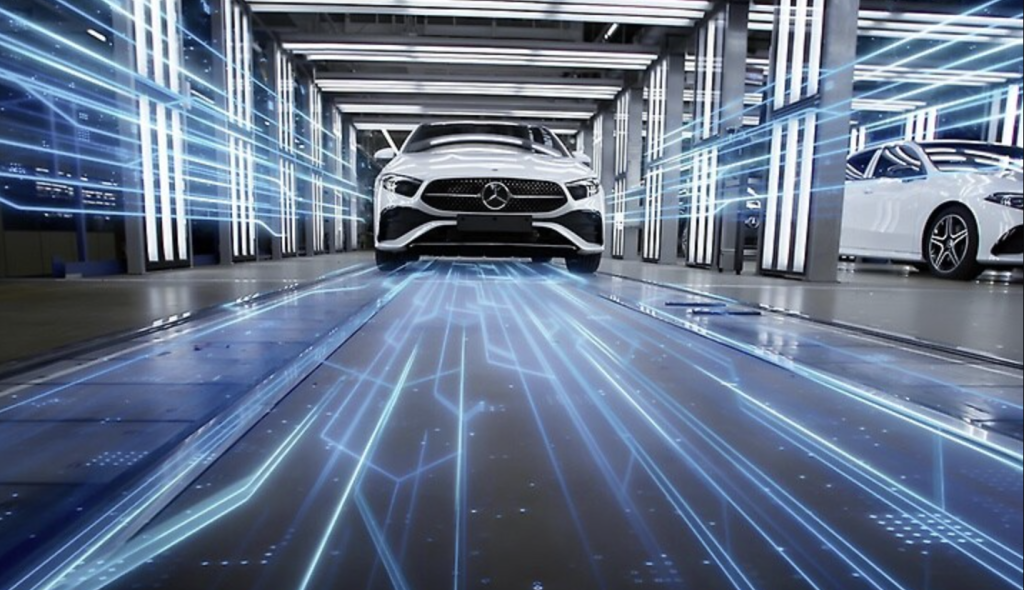
At Mercedes-Benz, the investment in digitisation, digital twins and AI is intended to make production more flexible and environmentally friendly. The MO360 AI Factory at the Mercedes-Benz Digital Factory Campus (MBDFC) in Berlin serves as its innovation hub. A big focus is on intuitive AI applications that can be used by anyone, with no advanced IT background required. The in-house Digital Factory Chatbot is one example. Using the familiar chatbot interface, workers can pose questions about the specific machine, and the AI offers an immediate response in their language of choice. Mercedes tells Automotive World that the combination of AI solutions, digital twin and digitalisation more broadly is expected to reduce production costs by 10% between 2024 and 2027.
Driving investment
Hopes are clearly high that smart factory investments will pay off in all sorts of ways, from safety and productivity to energy consumption. Nissan is already claiming a 20% energy savings. Mercedes expects a 10% drop in production costs. Audi is optimistic for a 50% improvement in efficiency. “Smart factories will be an absolutely huge opportunity,” enthuses Melrose.
Others are similarly bullish. Driven by advancements in robotics, edge computing, sensors and AI, the global smart factory market is poised for considerable growth. MarketsandMarkets forecasts its value will rise from US$104.42bn in 2025 to US$169.73bn by 2030. But like any investment, these technologies entail considerable financial outlay, not to mention disruption to existing operations.
“Many of these automotive players have a lot of older plants with older equipment, and it will take them a while,” cautions Hockenbrocht. “The investment is huge. They have to see the payback, the ROI, or the customer demand to start driving that kind of change.” For instance, one of General Motors’ criteria for potential suppliers is that they submit a plan for ‘lights out’ manufacturing, outlining a forward-looking blueprint for a human-less, or at least a human-light, production model.
Hockenbrocht concedes that he’s never had a client that’s executed a significant smart industrial programme without being told to do it by their customers, or as a result of government regulation. However, supplier requirements like GM’s and bullish projections on the financial benefits from automakers could be the prompt that some need to start acting on their digital blueprint.
Articles,Manufacturing,OEMs,Megan LampinenMegan Lampinen#softwaredefined #factory #hinges #ROI1774270204

More Stories
Pony.ai, CATL partner on first L4 electric light truck
UK lays regulations for automated passenger services
Leapmotor reveals China-only B05 Ultra at Beijing show