

Europe’s battery strategy has shifted from building a local champion to recruiting companies already leading in the global race. By Stewart Burnett
French President Emmanuel Macron is visiting Japan and South Korea this week with economic security among his primary objectives, as France deepens its effort to attract Asian battery manufacturers to invest in domestic production capacity. The visit follows a December 2025 trip to China, where Macron welcomed expansions to the country’s investments in France and co-signed a range of cooperation agreements.
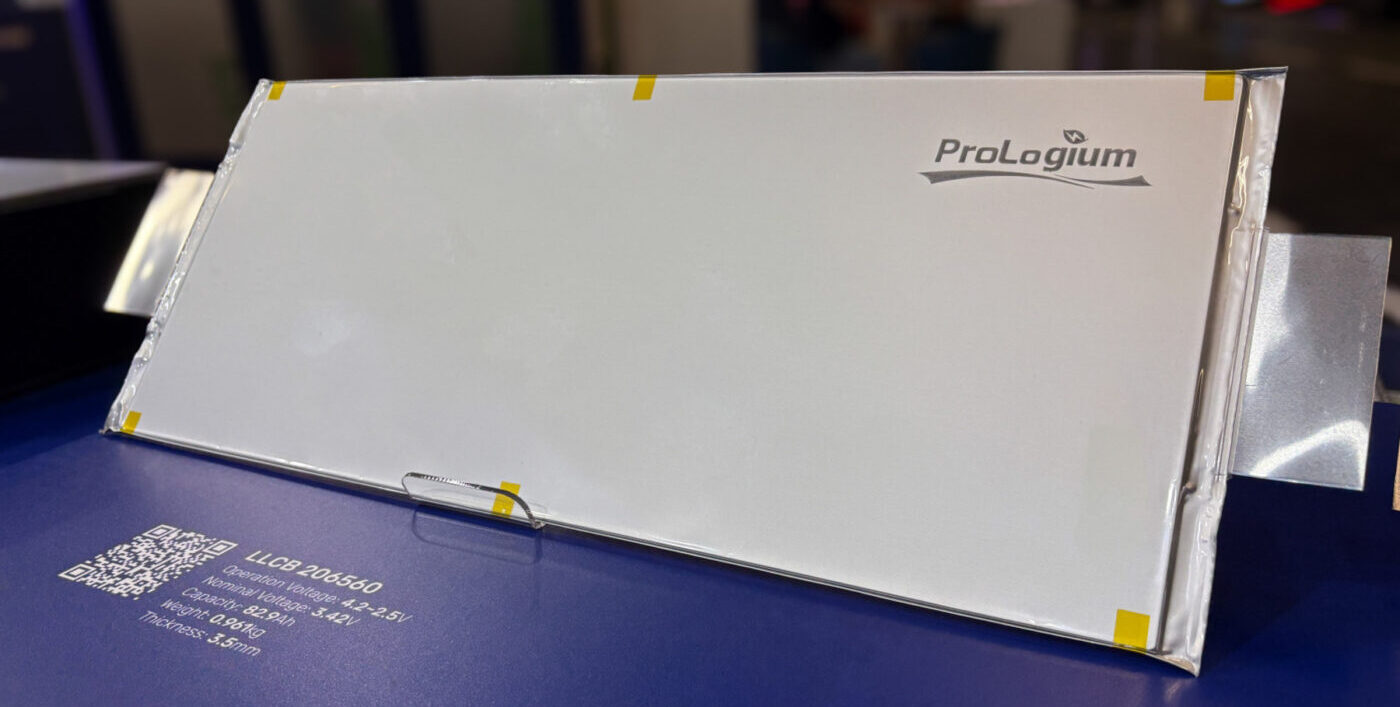
Macron’s diplomatic offensive has already produced one tangible result for local battery production. In February 2026, Taiwanese solid-state battery firm ProLogium broke ground on a factory in Dunkirk after receiving approximately €1.5bn (US$1.75bn) in French government subsidies. This sum will account for roughly 30% of the plant’s total construction costs.
On opening, the factory will have a modest annual capacity of just 0.8 GWh with production lines expected to begin operating in 2028. The initial small scale is largely a result of the still-tentative nature of solid-state technology, which has only seen limited deployment in series production vehicles thus far. The goal is to scale to 4 GWh by 2030 and a long-term ceiling of 48 GWh across the full site.
The ProLogium plant will produce fourth-generation lithium-ceramic solid-state batteries, a chemistry that boasts significant advantages in safety, range, and charging speed over conventional lithium-ion cells. According to Nikkei, ProLogium Chief Executive Vincent Yang has gone as far as to directly attribute the choice of France as a production hub, in part, to his relationship with Macron.
The Dunkirk site joins a cluster of battery facilities in northern France that has drawn comparisons to a regional industrial hub, with Verkor having opened a factory there in December 2025 and AESC and ACC operating nearby at Renault and Stellantis sites respectively.
France’s battery ambitions are shaped by the continent’s broader structural vulnerability. As it stands China dominates the global electric vehicle battery supply chain, claiming more than 80% of the global market against Europe’s 7%. This leaves global automakers significantly exposed to geopolitically-induced disruptions to trade—something the industry is already familiar with in the wake of China’s export restrictions on rare-earth elements during 2025.
Indeed, rare-earth dependency has become a recurring pressure point: France and Japan agreed a joint refining project in 2025, and the EU is moving to raise lithium recycling rates from 50% to 80% by 2031 as part of a broader effort to reduce exposure to Chinese material supply. Over in the US, efforts are also underway to obtain some degree of rare earth independence, with domestic firms including Noveon Magnetics, MP Materials and Arnold leading the charge.
Macron was among the staunchest advocates of the European Commission’s industrial promotion bill, published on 4 March. The bill contains provisions that reflect France’s preferred framework: a “Made in EU” requirement linking subsidies to minimum local production thresholds, and conditions on foreign investments above €100m from countries holding more than 40% of global production capacity in a given sector. The measure takes clear aim at China, requiring technology transfer and local procurement commitments.
Macron’s logic is substantiated by the continent’s fraught history with wholly-independent battery production. Northvolt, Sweden’s attempt to build a European battery champion from scratch, filed for bankruptcy in early 2025 after chronic production delays, quality failures, and the loss of major contracts including one with BMW. In the UK, Britishvolt collapsed before reaching production at all. Both pursued vertically integrated models built on proprietary technology that proved too difficult to scale quickly enough to compete on cost with established Asian producers.
France’s pivot would abandon the lofty goals of sovereignty those projects were designed to achieve, but delivers factories, jobs, and a degree of supply chain presence that the homegrown approach did not.
E-Mobility,Manufacturing,Markets,News,Stewart BurnettStewart Burnett#Macron #courts #Asian #battery #makers #East #Asia #tour1775032244
More Stories
Pony.ai, CATL partner on first L4 electric light truck
UK lays regulations for automated passenger services
Leapmotor reveals China-only B05 Ultra at Beijing show