


Apollo Go has benefitted greatly from Wuhan’s autonomous driving laws, but now finds itself facing scrutiny over a still-unexplained mass outage. By Stewart Burnett
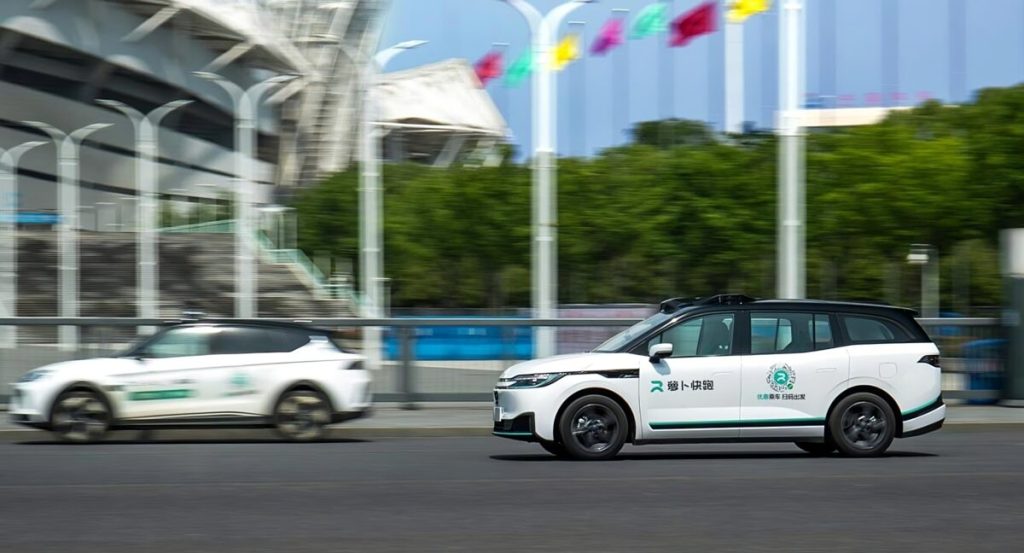
More than 100 Apollo Go robotaxis operated by Baidu stalled simultaneously on roads across Wuhan on 31 March, leaving passengers stranded in stationary vehicles for up to two hours while customer service systems failed to respond. Wuhan police attributed the incident to a system fault that remains under investigation; at least three collisions were subsequently reported by other road users encountering the stopped vehicles.
No fatalities or serious injuries have been reported at the time of writing, but one driver’s SUV sustained significant front-end damage after the car ahead changed lanes abruptly to avoid a stationary Apollo Go unit. Reminiscent of the fallout from the Xiaomi SU7 driver-assist crash from March 2025, the incident sparked widespread discussion on Chinese social media; particularly as it concerns the safety of autonomous driving technology. Among the videos shared online was dashcam footage of a car passing 16 immobilised Apollo Go robotaxis in a span of ninety minutes, and drivers braking sharply or changing lanes at the last second to avoid them.
At the core of the incident is the failure of Baidu’s emergency infrastructure. Passengers reported that in-car SOS buttons returned an “unavailable” message, calls through the vehicle screen were automatically disconnected, and the official customer service line offered assurances that a technician was en route without one ever actually arriving. One passenger on the Third Ring Road elevated highway—speaking to Chinese outlet DuTe News while still inside his vehicle—reportedly waited nearly two hours before police and Baidu staff reached him. Another complained he was still charged the full fare for the journey.
Shortly after the incident, Wuhan police published a statement confirming the scale of the outage and noting that all passengers exited safely. However, the cause has not been formally disclosed, and Baidu has not responded to media requests for comment. The only word thus far has come from its customer service department, which attributed the incidents to network issues.
Apollo Go is among the largest commercial robotaxi services in the world, operating either paid services or testing operations across more than 22 cities worldwide. As of February 2026, the company reported 20 million cumulative rides and more than 300 million kilometres of autonomous miles driven. The company is rolling out commercial services in both Abu Dhabi and Dubai, and is planning for likewise in Switzerland.
However, China remains the company’s bread and butter, and Wuhan has served as one of the company’s most permissive deployment environments. Local regulations have been designed to facilitate robotaxi deployment, permitting fully driverless vehicles on highways and airport routes. The city’s status as a flagship market for the service arguably makes the outage particularly damaging—it is precisely the conditions Baidu has been held up as having mastered that produced the most dangerous situations on the night.
It should be noted, of course, that mass fleet stalls are not unique to Apollo Go. In late 2025, a power outage in San Francisco caused dozens of Waymo vehicles to enter a fail-safe mode and stop in intersections, blocking traffic until remote operators intervened. Earlier incidents with GM’s Cruise service in the same city included vehicles converging on a single intersection following a software path-finding failure and a separate cluster stall linked to network congestion during a large outdoor event.
The incidents that have drawn the most scrutiny in autonomous driving have typically involved vehicles making incorrect decisions at speed. The aforementioned SU7 crash, and the high-profile Tesla Autopilot-related crash in Florida are both emblematic of this trend. However, the Wuhan outage highlights a different risk profile: a fleet-wide software event that turns every affected unit into a static hazard, in the precise locations where the service had been granted its greatest operational freedom.
Autonomous Driving,Markets,News,Software-Defined Vehicle,Stewart BurnettStewart Burnett#Mass #outage #halts #Baidu #robotaxi #fleet #Wuhan #roads1775028335


More Stories
Pony.ai, CATL partner on first L4 electric light truck
UK lays regulations for automated passenger services
Leapmotor reveals China-only B05 Ultra at Beijing show