

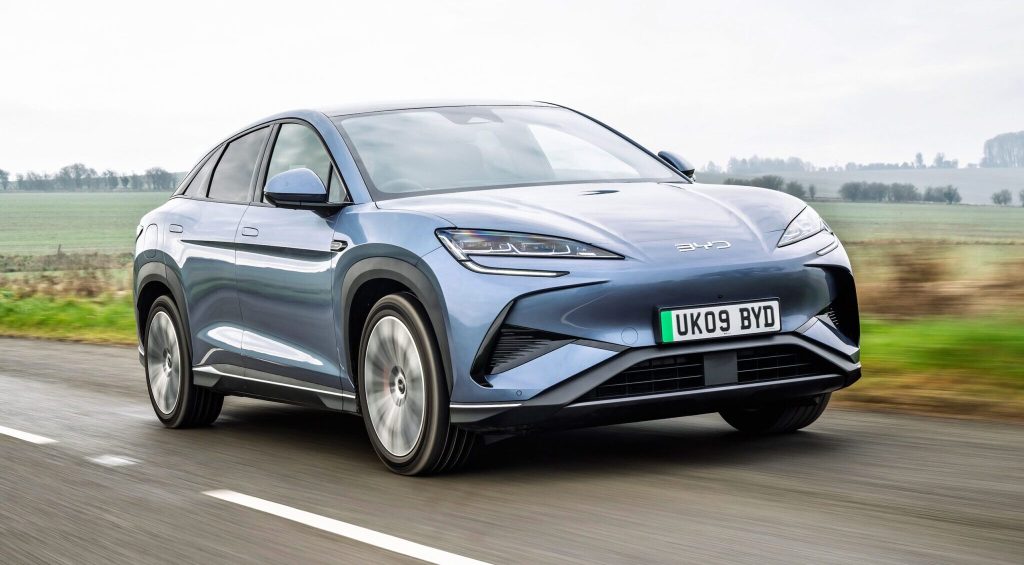
BYD is simultaneously upgrading existing bestsellers and launching flagship SUVs with its Blade Battery 2.0 technology. By Stewart Burnett
BYD has launched the updated 2026 Sealion 05 series and confirmed that the third-generation Yuan Plus—sold outside China as the Atto 3—will debut with its new Blade Battery 2.0 and flash charging system at the Beijing Auto Show on 24 April, extending the technology from luxury models to two of its highest-volume products. The Sealion 05 EV charges from 10% to 70% in five minutes; the plug-in hybrid (PHEV) DM-i variant achieves a combined range of 2,105 km on a full tank and charge.
The Sealion 05 DM-i is priced from CN¥97,900 (US$14,360) and the battery-electric (BEV) version from CN¥119,900. The EV’s maximum range extends to 630 kilometres, with 0-100km/h acceleration of 5.9 seconds. High-end trims include the God’s Eye C driver assistance system; buyers can optionally add LiDAR to access the more capable God’s Eye B suite for urban autonomous navigation.
The flash charging technology is, of course, the biggest development. The charging speeds—in some cases as low as five minutes—are achieved through the redesigned Blade Battery that halves internal resistance and heat generation. The cathode uses a multi-sized particle structure that allows lithium ions to enter and exit more efficiently, enabling the battery to accept up to 1,500 kW of charge. This contrasts against 325 kW for the Tesla Supercharger, which remains by and large the fastest widely-available charger in Western markets.
BYD is deploying 6,000 flash charging locations globally outside China, with 600 UK sites in the first wave and more in Europe. The automaker has told Wired that the European-deployed system currently operates at around two-thirds of its theoretical capacity. With time, it believes it will gain the means to advance to full speed; it should also be noted that BYD has applied to become the first Chinese-origin automaker with European Automobile Manufacturers’ Association (ACEA) membership.
The Denza Z9 GT, BYD’s premium brand opening salvo in Europe, was the first overseas model to carry the fast-charging system, launched at €115,000 (US$134,500). Some reviewers have singled out the unusually high price, even when tariffs are factored in. Indeed, the same car retails for the equivalent of around €55,000 in Australia. The Z9 GT produces 1,140 horsepower and accelerates to 100km/h in 2.7 seconds; range is a more modest 598 kilometres.
Also expected at the Beijing show is the Sealion 08, a three-row SUV exceeding five metres in length which is intended to serve as a flagship offering. The model will be offered in both BEV and PHEV variants. The BEV is expected to use an 800-volt architecture with the second-generation Blade Battery; dual-motor versions are anticipated to exceed 480 kW. Roof-mounted LiDAR, air suspension, and possible rear-wheel steering place it firmly in the premium segment rather than the volume mainstream territory that serves as BYD’s bread and butter.
Clearly, BYD is looking to advance its charging technology as far and wide as possible, across all tiers of its model lineup—be it an entry-level hybrid or a premium segment debut for Europeans. One of the most persistent objections to BEV adoption has been slow charging. BYD is effectively demonstrating that this does not need to be the case—provided consumers are willing to adopt its products en masse in global markets.
E-Mobility,Markets,News,OEMs,BYD,Stewart BurnettBYD,Stewart Burnett#BYD #brings #fiveminute #flash #charging #mass #market1776784731


More Stories
Pony.ai, CATL partner on first L4 electric light truck
UK lays regulations for automated passenger services
Leapmotor reveals China-only B05 Ultra at Beijing show