



The US is the last major automotive market that China remains locked out of; legacy OEMs and lawmakers want to keep it that way. By Stewart Burnett
More than 70 US House Democrats have written to President Donald Trump urging him to maintain the Biden-era ban on Chinese automakers selling or manufacturing electric vehicles in the US, framing any market entry as an existential threat to American automotive. The letter, led by Debbie Dingell and Ro Khanna, follows a similar push by three Democratic Senators earlier in April and arrives weeks before Trump’s planned summit with Chinese President Xi Jinping.
The Biden administration imposed the comprehensive restrictions in January 2025, citing national security concerns over connected vehicle technology and the potential for Chinese-made cars to collect sensitive data on American owners—particularly those in sensitive government and private positions.
Existing tariffs of around 100% on Chinese-made electric vehicles (EVs) compound the formal prohibition, though recent surveys suggest that US consumer interest in Chinese models is rising despite the government’s best efforts. It should also be noted that average purchase prices of new cars surpassed US$50,000 in 2025, while equivalent vehicles in China cost between a quarter and one third of their US counterparts.
Still, the same lawmakers that have made affordability a core part of their platforms now find themselves arguing in favour of an increasingly unpopular status quo. “We must not cede the American auto industry to a strategic competitor intent on global dominance,” the lawmakers wrote, calling for “clear and decisive action” to prevent Chinese automakers from entering the market in any capacity.
The White House reaffirmed that national security would not be compromised in pursuit of investment, while the Chinese Embassy urged Washington to “stop overstretching the concept of national security” and provide a non-discriminatory business environment. The exchanges reflect a widening—and rather surprising—fault line in US policy: in January 2026, Trump told the Detroit Economic Club he would welcome Chinese automakers building factories and hiring US workers, a position that has alarmed both legacy automakers and their suppliers.
Trump was the one who initiated the initial trade war with China during his first term in office. Now, the summit with his counterpart in China is a sharp source of anxiety for industry and lawmakers alike. The concern in Detroit and on Capitol Hill is that Trump may treat market access for Chinese automakers as a tradeable concession—offering entry in exchange for agricultural purchases or broader trade commitments—effectively resolving a geopolitical negotiation at the auto industry’s expense.
The industry’s own position is unambiguous. Auto trade groups representing nearly all major automakers (Tesla being the most noteworthy outlier) wrote to the Trump administration in March urging Chinese automakers be kept out at all costs, framing the prospect of state-subsidised Chinese competition as an existential threat to domestic producers. The Alliance for Automotive Innovation has characterised the scenario in stark terms, warning that vertical integration and government backing would allow Chinese brands to undercut U.S. manufacturers on price regardless of where the vehicles are assembled.
Ford Chief Executive Jim Farley took to a Fox News morning show last week to urge the same sentiment—Chinese automakers gaining market access would be “devastating to [the] country” in terms of manufacturing. The show in question, Fox and Friends, is known to be among Trump’s most-watched shows, and he has personally called into the show on multiple occasions.
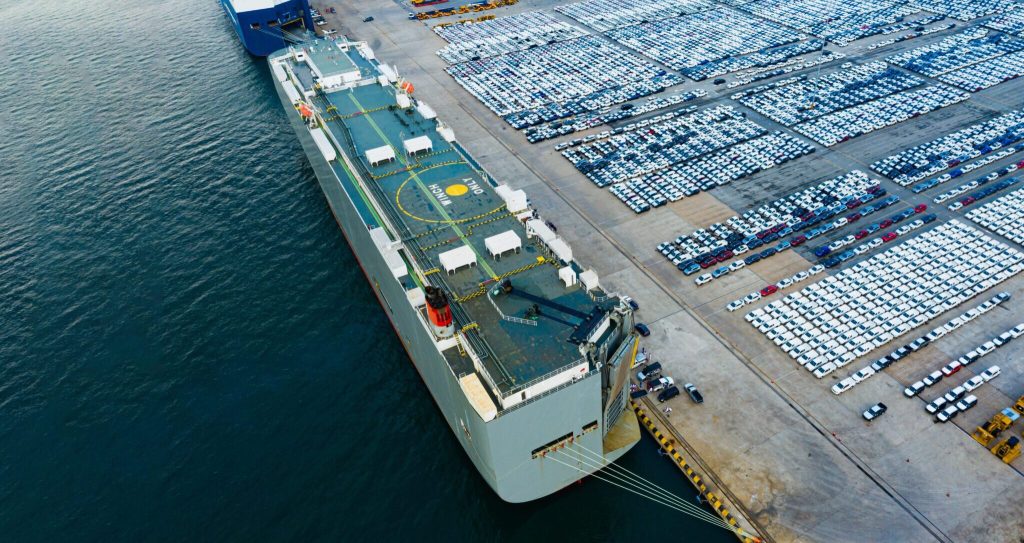
The EU arguably demonstrates the impact that Chinese market entrants can have on legacy automakers. Europe as a whole now accounts for 42% of all Chinese EV exports by value when the UK, Norway, and Switzerland are included, a share that has risen sharply since EU tariffs of up to 35.3% took effect in late 2024 and Chinese automakers accelerated local production in Hungary and Turkey to preserve their access.
The implicit argument in the Democratic letter is that Europe’s experience—a surge in Chinese vehicles despite tariffs, and a manufacturing base under acute pressure—is precisely what the US must avoid. The US is the last major automotive market that Chinese automakers remain locked out of, following Canada’s conditional tariff reductions earlier in 2026. It remains to be seen whether this will remain the case after the US-China summit in May.
E-Mobility,Manufacturing,Markets,News,OEMs,Stewart BurnettStewart Burnett#Democrats #urge #Trump #China #car #ban #summit #looms1777469054

More Stories
Solaris to supply 101 electric buses to Stockholm fleet
China suspends new AV permits after Baidu’s mass outage
Mercedes’ car division earnings lag behind the group