



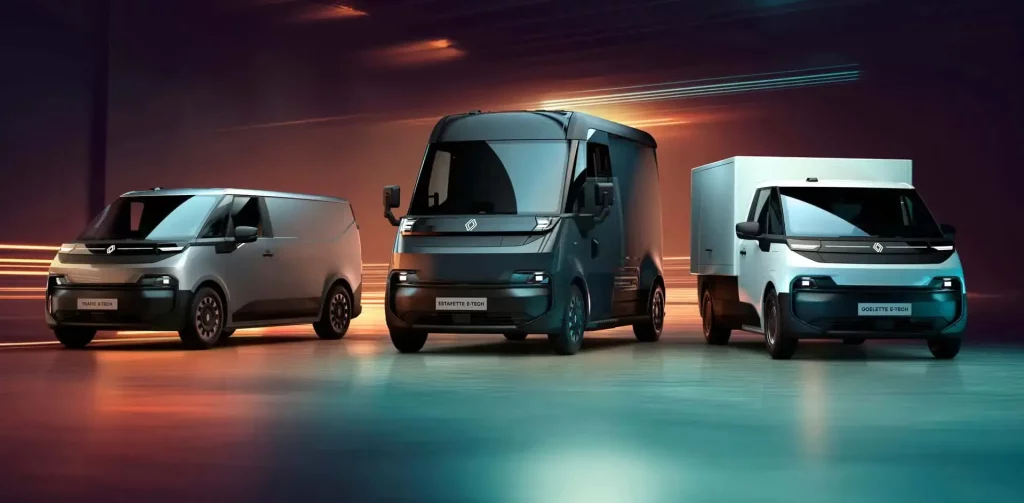
Renault is consolidating control of Flexis just as its first e-van prepares to enter production, and the move fits a broader pattern. By Stewart Burnett
Renault has signed a binding agreement to take full ownership of Flexis, the electric light commercial vehicle (LCV) joint venture (JV) it established with Volvo Group and CMA CGM in 2024. Under the deal, Renault will purchase Volvo Group’s 45% stake and CMA CGM’s 10% stake, subject to antitrust approval, with the transaction expected to complete during the first half of 2026.
In a press release, Renault emphasised that the governance change does not affect the project’s timeline or ambition. Production of the first of three planned vehicles—the Trafic Van E-Tech electric—remains on track to begin at Renault’s Sandouville plant in Normandy by the end of 2026. Around 1,300 people are currently working on the programme across sites in the Île-de-France region and Normandy.
The Flexis platform centres on a purpose-built skateboard architecture, an 800V electric system enabling a charge from 10% to 80% in around 18 minutes, and a self-described software-defined vehicle architecture designed to facilitate connectivity functions, over-the-air updates and logistics integration. The three models currently under development comprise a step-in van, a cargo van and a panel van.
Volvo Group will remain involved in the JV, albeit as a distributor rather than a part-owner. Through Renault Trucks—its long-standing partner for LCV operations—Volvo will market the Flexis range from 2027 onwards. CMA CGM, which joined the venture as part of its own decarbonisation strategy, will exit from the JV entirely as and when the transaction closes.

The buyout follows an established pattern at Renault since the surprise departure of Chief Executive and electrification trailblazer Luca de Meo in June 2025. His replacement, François Provost, is more cautious but still has done little to renege on his predecessor’s ambitions. Instead, he has focused on boosting efficiency and safeguarding the same plans from potential failure. In the case of Flexis, the automaker is taking direct control over software development and production timelines at a moment when speed to market is arguably critical.
It is the second Renault project to be brought closer to its decision-making core in 2026. In January, Renault announced plans to reintegrate Ampere—its dedicated electric vehicle and software division, originally carved out as a prospective standalone public company—back into the group by mid-2026. Plans for an initial public offering were shelved after market conditions failed to support the valuation Renault sought.
The calculation in both cases appears to be that independent joint venture and spin-off structures are harder to justify in a more volatile and uncertain market. With EV adoption slower than was first rather optimistically forecast and capital markets less receptive to such ventures, consolidating control in-house could offer Renault more flexibility, and bring it more in line with the broader ‘China-speed’ strategy—given the moniker ‘Leap 100’—of developing lower-cost vehicles and bringing them to market within 16 months.
Commercial Vehicle,E-Mobility,Manufacturing,News,OEMs,Software-Defined Vehicle,Renault Group,Stewart Burnett,Volvo GroupRenault Group,Stewart Burnett,Volvo Group#Renault #takes #full #control #electric #van #Flexis1771843630



More Stories
Pony.ai, CATL partner on first L4 electric light truck
UK lays regulations for automated passenger services
Leapmotor reveals China-only B05 Ultra at Beijing show