


The Toyota bZ4X is about to become the public face for Pony.ai’s seventh-generation robotaxi technology. By Stewart Burnett
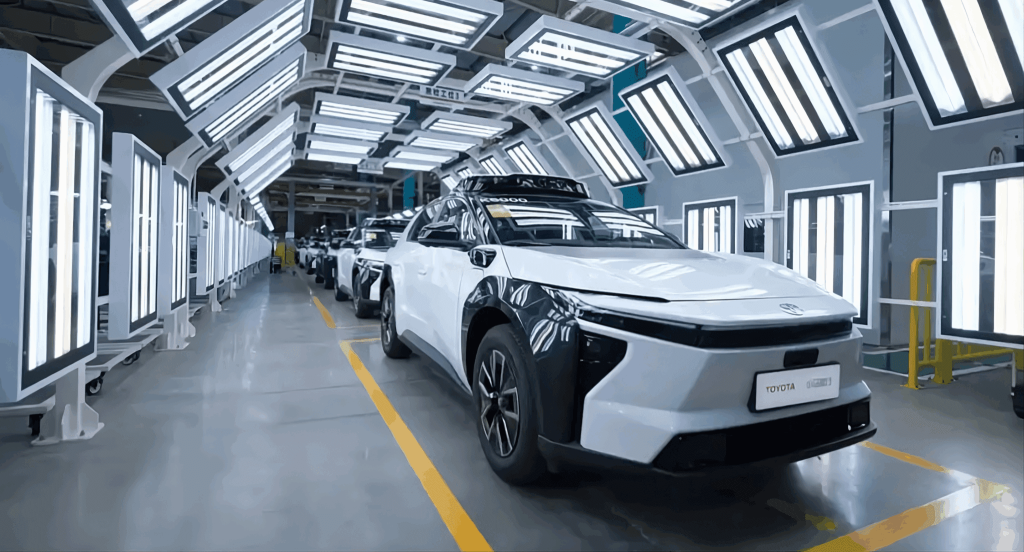
Pony.ai has started commercial production of a driverless vehicle in partnership with Toyota, rolling out the first of 1,000 autonomous Toyota bZ4X compact SUVs from an assembly line operated by the joint venture between Toyota and Chinese state-owned automaker GAC. The vehicle incorporates the updated bZ4X design and is equipped with Pony.ai’s seventh-generation autonomous driving system.
The parties cooperate through a joint venture comprising Pony.ai, Toyota China and GAC Toyota. Together, they aim to deploy a fleet of thousands of bZ4X robotaxis through 2026, with initial operations set to kick off in tier one Chinese cities. Toyota has an established history with Pony.ai, first investing US$400m million in the autonomous driving firm six years ago.
Toyota’s ambitions with fully autonomous driving do not extend beyond robotaxis. While the automaker has voiced its confidence about Pony.ai’s autonomous driving technology, it does not believe SAE Level 4 autonomy is ready to be sold in mass market vehicles just yet. Instead, it is focused on leveraging its new vehicle operating system, AreneOS, to enhance the driver-assist capabilities in upcoming models like the RAV4, due to launch later in 2026.
Prior to the bZ4X, Pony.ai’s fifth-generation robotaxis were based on the Lexus RX450h, while its sixth-generation vehicles used the Toyota Sienna. Both of these were internal combustion engine vehicles; the bZ4X, by contrast, is an electric vehicle with a 163 kW powertrain.
The robotaxi now entering production measures 4.69 metres in length, 1,86 metres in width and 1,650 metres in height with a wheelbase of 2,850 millimetres—rendering it essentially the same as its equivalent mass market model. What distinguishes it is the autonomy stack, which comprises 34 sensors: 14 cameras, nine LiDARs (supplied by Hesai), four millimetre-wave radars, and seven other sensors including ultrasonics and IMUs.
Pony.ai is looking to substantially scale its operations in 2026. Co-Founder and Chief Financial Officer Wang Haojun announced at a December 2025 media briefing that its fleet size grew from over 200 vehicles in 2024 to nearly 1,000 by the end of 2025, and could reach as high as 3,000 vehicles by the end of 2026. Beyond China, the company is looking to build its presence in the MENA region, with operations in Europe likely to follow in 2027.
Wang indicated in December that, based on the company’s operational trajectory, Pony.ai may reach a fleet size of up to 100,000 vehicles by 2030, suggesting the company will achieve breakeven status before that date.
Autonomous Driving,Manufacturing,Markets,News,OEMs,Software-Defined Vehicle,Stewart Burnett,Toyota GroupStewart Burnett,Toyota Group#Pony.aiGAC #Toyota #robotaxi #enters #mass #production1770760428
More Stories
Pony.ai, CATL partner on first L4 electric light truck
UK lays regulations for automated passenger services
Leapmotor reveals China-only B05 Ultra at Beijing show