


By deploying a world model autonomous driving system in a mass-market vehicle, SAIC is testing the current limits of self-driving viability. By Stewart Burnett
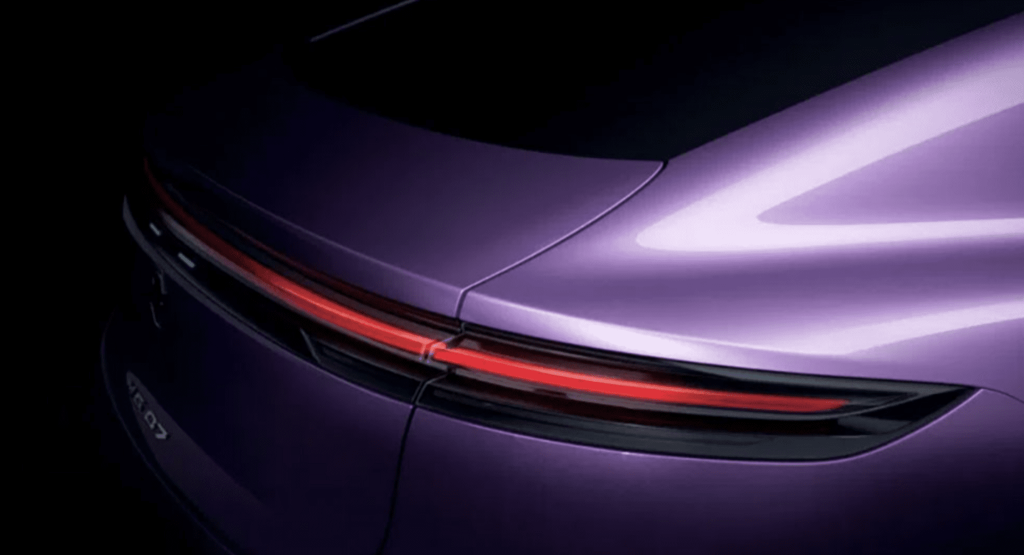
SAIC-owned MG has confirmed that its upcoming MG 07 fastback sedan will be among the first vehicles to use Momenta’s R7 autonomous driving system, combining a reinforcement learning-based world model with the Xheart X7 dedicated AI chip. The announcement was made at the Beijing Auto Show, with both companies pitching the R7 system as a direct challenge to Tesla’s Full Self-Driving (FSD) v14.
Talking to media, MG Brand Division General Manager Chen Cui stated that the MG 07 would share the R7 configuration with models otherwise priced at CN¥300,000 (US$44,000) and above. In other words, it was putting a system typically associated with China’s premium segment inside a mass-market. The stated intent is to deliver above-category driver assistance performance, although no comparative benchmark data was published.
Momenta Chief Executive Cao Xudong described R7 as reinforcement-learning-based and aligned with FSD V14 at the system level. To be sure his comments may warrant further scrutiny: he did not offer any verified Tesla data to substantiate his arguments, instead referring to internal observations of FSD behaviour.
Momenta’s relationship with SAIC predates the MG 07 by several years. SAIC led the company’s US$500m Series C round back in 2021, establishing a deep integration that has since extended across the group’s portfolio. This includes the IM Motors premium brand, SAIC-GM’s China-exclusive Buick lineup, as well as a confirmed role in the Audi-SAIC joint platform for China. The R7 deployment in the MG 07 represents a downward migration of that technology stack from the flagship tier into volume production.
This dynamic, of pushing high-end driver-assistance systems into mid-market vehicles, is arguably one of the more distinct characteristics in China’s race for autonomy leadership. Cao argues there is a rationale for this beyond competitive positioning: the higher density of pedestrians, two-wheelers and logistics vehicles on Chinese roads makes for a richer and more diverse training environment than the predictable dynamics of Western roads.
Momenta has also claimed that R7 model updates complete post-training iterations in less than three hours, with full training cycles spanning days. This, in practice, means it is possible to deploy weekly incremental software updates to its deployed vehicles. Momenta’s equipped fleet is scaling from roughly 80,000 units toward a projected 200,000 by the end of 2026.
It has set a long-term target of deploying its technology in more than 10 million vehicles. This inevitably means it will need to lean on overseas expansion; to this end the company is already planning robotaxi deployments in Europe via an Uber partnership later in 2026.
Autonomous Driving,Markets,News,OEMs,Software-Defined Vehicle,SAIC,Stewart BurnettSAIC,Stewart Burnett#debut #Momentas #system #apparent #Tesla #challenge1777549290

More Stories
Stellantis “reset” in progress, but is it convincing?
Mitsubishi pivots to HEVS in Japan amid flat PHEV demand
International Motors launches My International