



Samsung SDI completes the trifecta of premium German automakers with a Mercedes-Benz battery supply deal. By Stewart Burnett
Samsung SDI has inked a major multi-year deal to supply high-capacity nickel-cobalt manganese (NCM) batteries to Mercedes-Benz, marking the South Korean battery maker’s first supply agreement with the German automaker. Although precise details remain unconfirmed, the contract value is expected to come in above KRW 10tr (US$6.8bn), with supply volumes expected to reach tens of gigawatt-hours.
The batteries are destined for Mercedes-Benz’s next-generation compact and mid-size electric SUVs and coupe models, targeting a 2028 launch. They will feature Samsung SDI’s high-nickel prismatic cell format, which is apparently ideal for the automaker’s modular electronic architecture platform, which underpins its compact and mid-sized model range. It is designed to be adaptable across multiple powertrains, rendering it suitable for both pure-electric and plug-in hybrid powertrains.
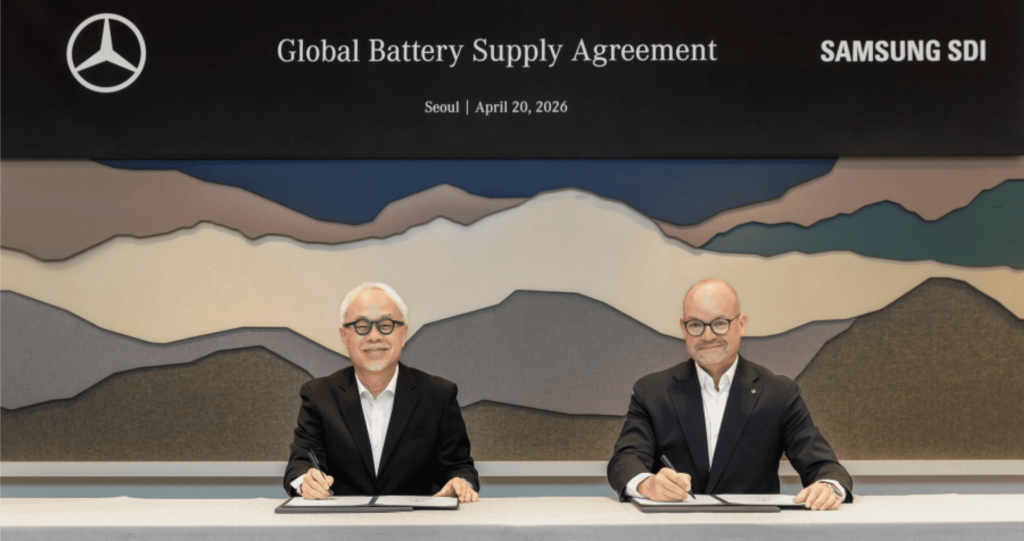
The deal was signed in Seoul, attended by both Samsung SDI Chief Executive Choi Joo-sun and Mercedes-Benz Chair Ola Kallenius. It marks what is effectively a clean sweep of Germany’s entire premium vehicle segment; Samsung SDI already has supply arrangements with BMW and Volkswagen. Mercedes-Benz completes the sweep, and now the two companies have indicated plans to broaden their cooperation to include the joint development of next-generation battery technology.
Over the last couple of years Mercedes has gradually broadened its battery supply base—indeed, it already sources cells from LG Energy Solution and SK On. The Samsung SDI agreement is intended to add a premium tier, capable of competing with China’s most advanced battery technologies albeit with established European production capability.
That European capability centres on the battery maker’s Göd plant in Hungary, which is one of the continent’s largest battery facilities. At the time of writing, the plant operates at approximately 40 GWh of annual capacity and employs over 6,000 people. Future expansion plans could see its capacity ceiling raised to 60 GWh or higher. The plant is currently transitioning from wound to stacked prismatic cell production, which offers higher energy density, while also ramping cylindrical 46-series cells for BMW’s Neue Klasse platform.
The Göd facility has been the cornerstone of Samsung SDI’s European strategy, but it is now the subject of significant political and environmental scrutiny following the election victory of Peter Magyar’s Tisza Party earlier in April. Magyar campaigned on, among other things, tighter oversight of the battery industry and an end to preferential energy arrangements with Russia that had ensured lower production costs under the outgoing Viktor Orban.
Samsung SDI declined to comment on the political situation in Hungary, though an industry source said the company is seeking to cooperate with the incoming government’s environmental policy. Reports of carcinogenic nickel and cobalt levels at the Göd site at concentrations far exceeding legal limits have added to the complexity. The new deal with Mercedes-Benz, and the 2028 supply obligation that it entails, add a degree of commercial urgency to resolving those issues.
E-Mobility,Manufacturing,Markets,News,OEMs,Mercedes-Benz,Stewart BurnettMercedes-Benz,Stewart Burnett#MercedesBenz #inks #premium #battery #deal #Samsung #SDI1776680511


More Stories
Pony.ai, CATL partner on first L4 electric light truck
UK lays regulations for automated passenger services
Leapmotor reveals China-only B05 Ultra at Beijing show