



Ford’s “Model T moment” is more of an efficiency lifeline than an industry step-change. By Megan Lampinen
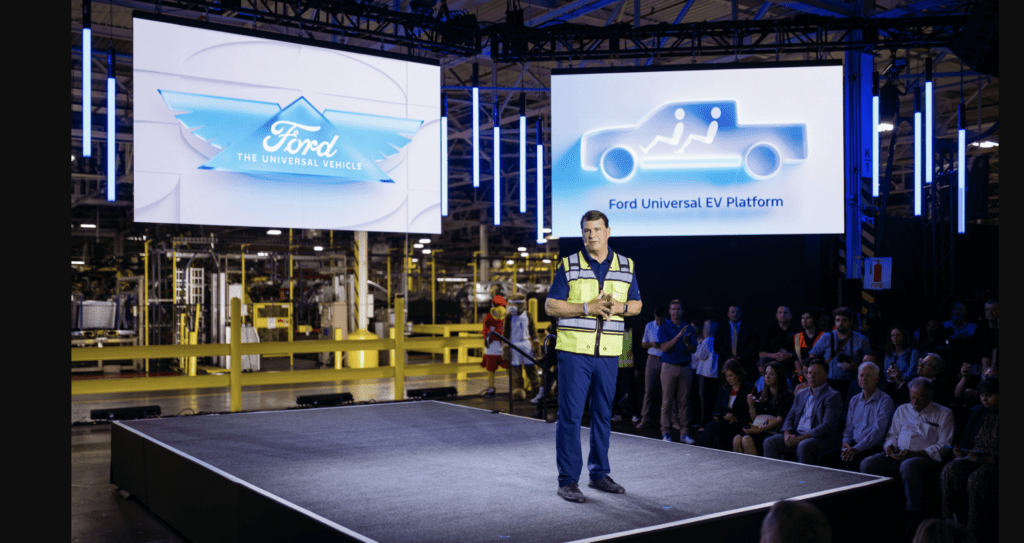
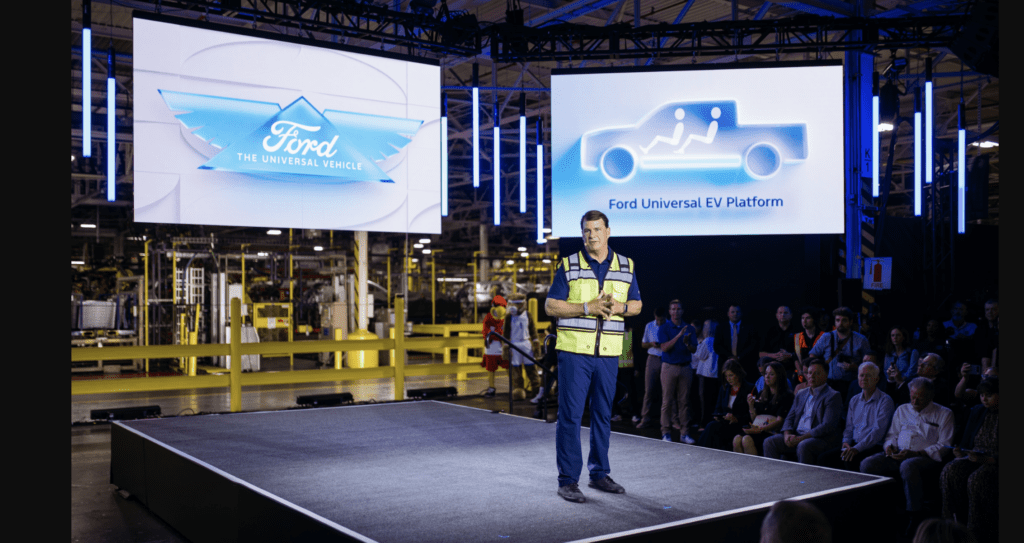
Ford has hailed its upcoming Universal Electric Vehicle Platform (UEVP) as the key to making affordable, desirable EVs in the wake of rising competition from China. It’s at the heart of a significant shift in how the company designs, engineers and builds vehicles.
The language Ford uses around it is dramatic, with talk of “game-changing” and “unique” approaches that will herald a new “Model T moment”. Many of these new procedures represent a decided modernisation of the company’s working practices and could provide an efficiency lifeline for its struggling Model e business, but in the context of wider industry innovation, they may be more of an evolution than revolution.
Helpful, if not unique
The UEVP is intended to introduce a modular framework that underpins a wide range of more efficient and affordable vehicles, starting with a US$30,000 mid-size electric pick-up in 2028. Such modular platforms designed specifically for EVs can cut down development time and save costs, though they are not unique: Volkswagen Group has the MEB platform, General Motors has Ultium and Stellantis has STLA, among others. VW has said that the MEB’s unified cell approach and economies of scale should help it to slash battery costs by up to 50%. It is also designed to improve plant productivity by 20-30% and cut development time for new models from 50 to 36 months. Ford will be chasing similar results.
Then there’s Ford’s adoption of the assembly tree manufacturing setup, where instead of a single long, linear conveyor, the vehicle is divided into three or four major modules which are assembled on their own line simultaneously and then joined together. Each separate module is created by ‘unicasting’, essentially Ford’s version of the gigacasting approach introduced by Tesla. Both use large high-pressure die-casting machines to create vast single-piece aluminium structural components that can be assembled much faster and easier than welding hundreds of small pieces together. The Chinese are also early movers here, and Dongfeng recently installed the world’s largest gigacasting machine, with a clamping force of 17,600 short tons and housed in a specially built 538,200 sq-ft facility. The clamping force indicates the size of the body parts that can be produced: BYD operates 9,000-ton machines while Tesla started at about 6,000 tons.
Ford hasn’t shared any details but it’s first UEVP pick-up will have just two front and rear structural parts compared to 146 in the current Ford Maverick. It In comparison, BYD’s 9,000-ton machines have reduced the number of parts in the front and rear cabin floors from 74 to a single integrated casting.
As for Ford’s “re-imagined” E/E architecture, this involves moving from 12V to 48V and embracing a zonal architecture to reduce system complexity. IoT Analytics reports that more than 90% of automotive manufacturers have now committed to zonal architecture, with about 80% already starting the migration. As such, Ford’s move isn’t unique, but it is impactful: engineers claim to have made the first UEVP model’s wiring harness 4,000 ft shorter and 22lbs lighter than in Ford’s first-generation EVs. Similarly, Rivian’s move from a domain to a zonal architecture with the second-generation R1S and R1T eliminated 1.6 miles (8,448 ft) of wiring and shed 44 lbs of weight.
Where Ford goes slightly off-piste, at least from a US perspective, is with the structural battery approach. Here, the battery pack is no longer just a large part that has to be installed in the vehicle but rather a load-bearing structural element of the vehicle body. While Ford can claim a first for the US market, China’s BYD has already emerged as a leader in structural battery design. This approach helps reduce weight and improve stiffness, which subsequently reduces energy loss during driving and increases the range. By scaling back the quantity of discrete parts, it can also mean less manufacturing complexity and cost.
However, there can be a trade-off: “Greater integration brings challenges, particularly around repair and serviceability,” explains Mickey Crozier, Chief Engineer—Component Manufacturing Technology at the Manufacturing Technology Centre (MTC). In conventional battery architectures, a damaged battery pack can be removed and reworked by replacing a module or cell. Structural batteries reduce this flexibility, as replacing a failed cell may require structural repairs instead, potentially increasing scrap rates. A Ford spokesperson, insists that in its case, “the electronics and battery remain serviceable,” without elaborating. Further details should emerge as the first model nears production.
Systems-level thinking
Ford shows greater differentiation with its new ‘Bounty’ strategy, built on the principles of value engineering and the bug bounty programmes used in cyber security. In Ford’s approach, reducing vehicle inefficiency is treated systemically instead of at an individual part level. Engineering teams have assigned numerical metrics to key factors like mass and aerodynamic drag, which directly impact vehicle efficiency, battery range and cost. On the surface, it may not make sense to increase the cost of a specific component just to decrease weight, particularly in a vehicle that only costs US$30,000. However, by giving weight reduction a value in terms of battery cost, the team can determine whether spending more to make a part lighter saves more money than making a larger battery.

Ford’s goal is to offer a profitable electric pick-up that is affordable to mass market consumers and competitive against offerings from China. Its EV efforts to date have struggled, with the Model e division reporting a US$4.8bn loss in 2025. Notably, Chief Financial Officer Sherry House expects it to remain loss-making for at least another two years, theoretically emerging into the black just as the first UEVP model hits the market.
An updated, more efficient manufacturing process for a unified set of parts and flexibility to make a wide range of models from a standard toolkit is very likely the solution everyone needs today—and most have already starting adopting. With this roadmap Ford shows itself not so much a manufacturing innovator but a determined follower. For a moment truly of Model T proportions, the industry will need to look elsewhere—probably China.
Articles,E-Mobility,Manufacturing,OEMs,Software-Defined Vehicle,Ford Motor Company,Megan LampinenFord Motor Company,Megan Lampinen#Ford #Model #catch #innovation1772611216



More Stories
Pony.ai, CATL partner on first L4 electric light truck
UK lays regulations for automated passenger services
Leapmotor reveals China-only B05 Ultra at Beijing show