

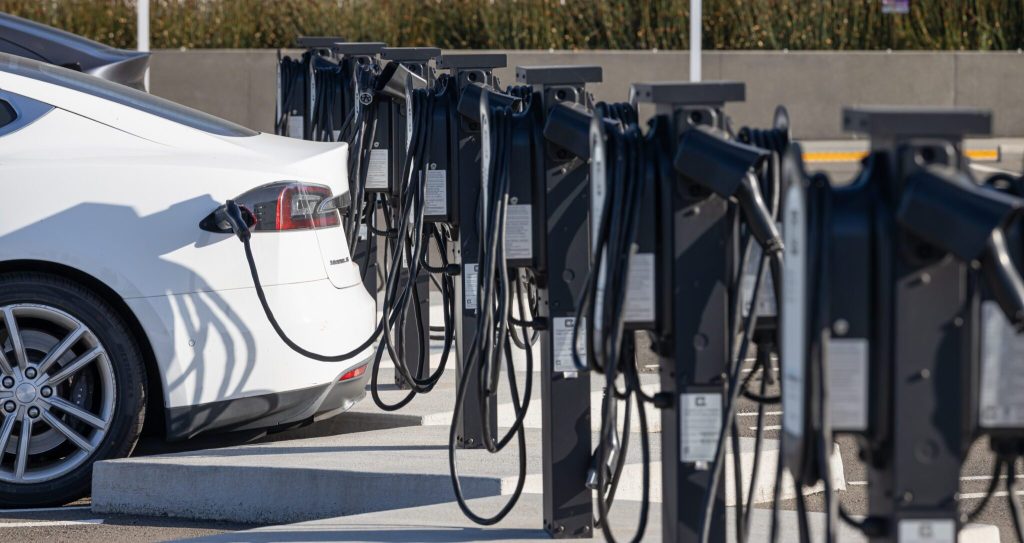
The elimination of federal EV purchase subsidies is having precisely the effect everybody expected it would have. By Stewart Burnett
Battery-electric vehicle (BEV) sales fell 40.2% year-on-year in California during Q1 2026, pushing the state’s zero-emission market share down to 13.7%, the lowest level since Q4 2021, according to new data from the California New Car Dealers Association (CNCDA). Hybrid vehicles jumped ahead to claim a 20.9% share, while internal combustion engine (ICE) sales rose back to 61.1% from 54% a year earlier.
The primary cause should be of no surprise: the US$7,500 federal tax credit was eliminated 30 September 2025, removing the single most effective financial incentive for BEV adoption. Total new vehicle registrations in California fell 8.9% to 416,810 units, suggesting that the entire market is experiencing softened demand. Still, at 40%, the BEV decline was nearly five times the overall contraction.
Tesla remained dominant in the segment in spite of its decline, registering 31,958 vehicles in the state during Q1—down 24.3% from 42,211 a year earlier. Its market share, irrespective of powertrain, slipped from 9.2% to 7.7%. The Model Y remained the top-selling light SUV in the state with 22,907 units; the Model 3 registered 5,688. Tesla’s share of the BEV segment actually rose from 44.2% to 56.0% as competitors collapsed harder: Mercedes-Benz ZEV registrations fell 81.9%, Chevrolet dropped 59.6%, BMW 58.9%, Ford 58.8%, and Kia 48.2%.
Fellow pure player Rivian posted the steepest decline of any of the top 30 brands tracked by CNCDA, with California registrations collapsing 35.9% to just 1,841 units. The result adds pressure to a full-year delivery guidance of 62,000 to 67,000 globally that requires the company to average 17,000 to 19,000 deliveries per quarter through the rest of the year—roughly 1.7 to 1.8 times the Q1 rate. The R2 midsize SUV, hyped for years and finally set to launch, will have to steer the automaker’s performance through the remainder of 2026.
Lucid was the only pure player among the seven tracked by CNCDA that actually posted Y.o.Y increases in the state, up 37.1% to 1,315 units, driven in part by the Gravity SUV ramp that began in late 2024. Despite heavy Saudi investments, the automaker remains heavily dependent on a single state for its sales: 42.5% of the company’s global Q1 deliveries actually came from California.
Only six other brands posted gains, all predominantly selling hybrids or ICE vehicles: Mitsubishi, Genesis, Lexus, Volvo, Chrysler, and Toyota. The quarter arguably complicates California’s trajectory toward its 2035 mandate requiring all new passenger vehicle sales be ZEVs. With heavy pressure from the Trump administration to turn back the clock towards fossil fuel dependence, Governor Gavin Newsom’s planned US$200m incentive programme for electrified vehicles has some disproportionately heavy lifting to recover market share lost to the larger federal scheme’s termination.
E-Mobility,Markets,News,OEMs,Stewart Burnett,TeslaStewart Burnett,Tesla#Californias #BEV #market #share #hit #fouryear1776861996
More Stories
Pony.ai, CATL partner on first L4 electric light truck
UK lays regulations for automated passenger services
Leapmotor reveals China-only B05 Ultra at Beijing show