


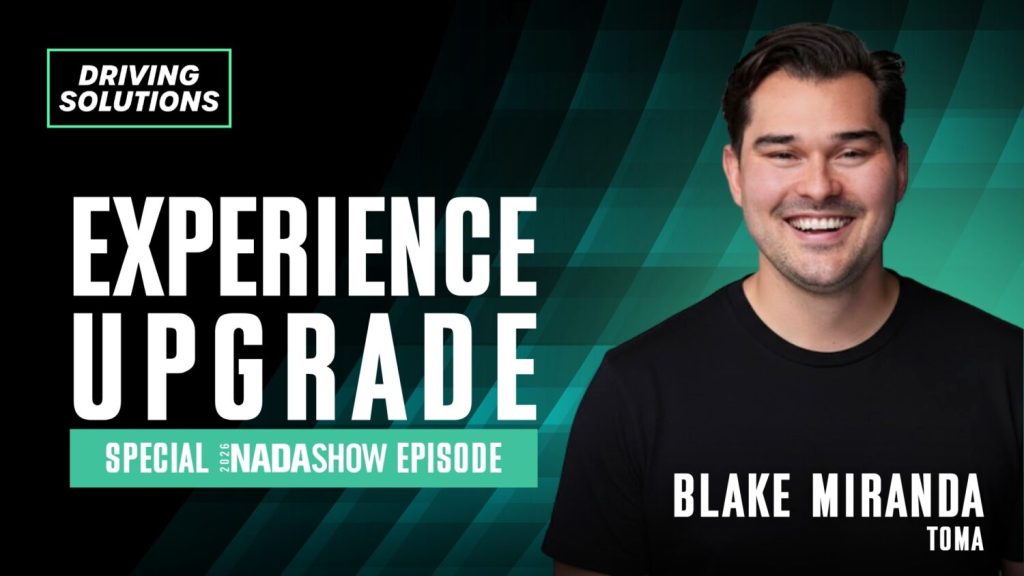
Service and fixed ops departments are leaving thousands of dollars on the table because customer calls continue to go unanswered. On today’s episode of Driving Solutions, Blake Miranda, head of OEM and partnerships at Toma, shares how the company’s AI operating system automates inbound calls, protects the customer experience, and helps dealers improve CSI scores.
Toma is an AI-driven platform designed to automate inbound calls, service scheduling and customer communication. While the platform primarily supports service and fixed operations, it also offers solutions that extend into variable operations. The core goal is to relieve dealerships of high call volumes, freeing up hours of staff time while ensuring customers receive consistent, timely responses.
Sign up for CBT News’ daily newsletter and get the latest industry stories delivered straight to your inbox.
To manage call volume, many dealers turn to building or expanding a BDC. However, staffing a BDC presents ongoing challenges, from hiring and training to retention. While outsourced BDC services can be effective, they are often costly and rarely serve as a one-size-fits-all solution, especially given the operational differences across brands and dealership groups.
Toma’s voice AI platform is built to be fully customizable to each dealership’s needs. Its end-to-end software also gives dealers deeper visibility into customer conversations, including which calls are handled by AI, which are transferred, and which may not need human involvement at all. In many cases, routine service inquiries and appointment scheduling can be resolved entirely through the AI, reducing unnecessary handoffs.
“Use this conference to experience AI. Introduce and familiarize yourself with it and take your time with it.”
The platform can manage full customer dialogues, schedule service appointments, and send reminders. Every call is transcribed, summarized, and organized within an internal inbox, giving service advisors and BDC teams a complete view of a customer’s call history. This visibility enables more informed follow-up and more efficient communication.
Through the inbox, advisors can respond to customers via SMS or allow Toma’s AI to reply on their behalf. An AI toggle allows staff to step in or step away as needed, while maintaining continuity in the conversation.
One of Toma’s most significant advancements is Toma IQ, a policy-driven onboarding and customization approach. During onboarding, Toma listens to inbound customer calls and analyzes conversation outcomes to identify dealership-specific policies and processes. These insights are then presented to the dealer for review, allowing them to approve or reject inferred rules before deployment. This process further personalizes the AI agent to each dealership, creating a level of customization that mirrors real-world operations rather than relying solely on static inputs.
Toma also supports outbound communication through text messaging, which Miranda notes is often the most effective and least intrusive way to engage customers. SMS reminders and notifications help maintain communication without negatively impacting the customer experience, while inbound calls remain fully supported when customers prefer to speak directly.
Toma will be exhibiting at the upcoming 2026 NADA Show, marking the company’s first year with a dedicated booth. Dealers can schedule a live demo here, and stop by Booth #7507N in the North Hall to experience the platform firsthand.
EVs & Technology,Driving Solutions,Featured,Toma,2026 NADA Show,artificial intelligence,fixed ops,fixed operations,NADA#Blake #Miranda #Tomas #role #recovering #missed #service #revenue1769472948
More Stories
Weekly roundup: FTC wants dealers to report deceptive pricing, Ford boost U.S. assembly, Carvana expands dealership portfolio
Autonomous future back in focus as Waymo expands, Uber reinvests billions
New car sales drop 7.3% in April, but don’t blame buyers