


Audi doubles down on a strategy that has yet to prove itself, with a brand that eschews its most recognisable asset. By Stewart Burnett
Audi and SAIC have deepened their ties with a new cooperation agreement which outlines plans to develop four next-generation models under the jointly-owned ‘AUDI’ brand that eschews the iconic four-ring badge. The models will all be electric and software-focused, built on an updated Advanced Digitised Platform; a dedicated innovation and technology centre will also be launched in Shanghai to support development.
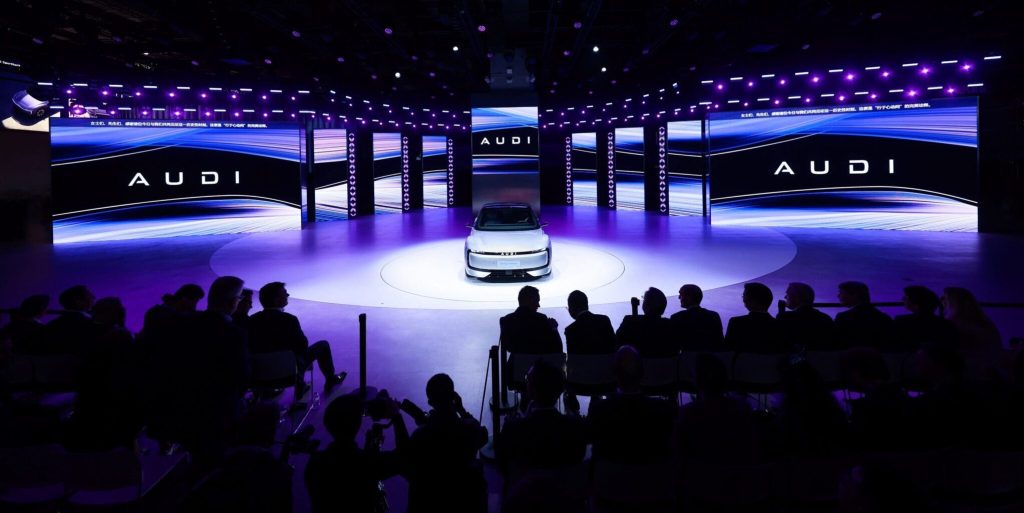
The agreement builds upon a partnership first launched in November 2024, establishing the AUDI brand as a speed-to-market oriented towards younger, more technology-focused premium buyers. In place of the four-ring badge, a more nondescript four-letter AUDI logo emblazons the vehicle’s front in capital letters.
Audi will lead efforts at the new R&D centre, which will focus heavily on AI and consumer-facing software products. Among the planned projects are AI cockpit systems, advanced driver assistance systems (ADAS) adapted to Chinese road conditions, and whole-vehicle development across the value chain.
A first SUV model, the AUDI E7X, will make its global debut at the Beijing Auto Show later in April; this predates the new partnership agreement. A third model from the first product offensive is scheduled for 2027, and the four models announced under the new agreement will follow in subsequent years.
The dual-brand strategy being deployed by Audi is deliberate. The automaker’s traditional four-ring lineup—which includes the Q6 e-tron and A6 e-tron built on platforms developed in Germany through Volkswagen’s Cariad unit—continues to serve its existing global and Chinese customer base. The ringless AUDI brand is intended to function as a parallel construct, designed to compete directly with native Chinese brands on their own terms: faster development cycles, software made in and for China, and technology features calibrated to local consumer expectations instead of being adapted.
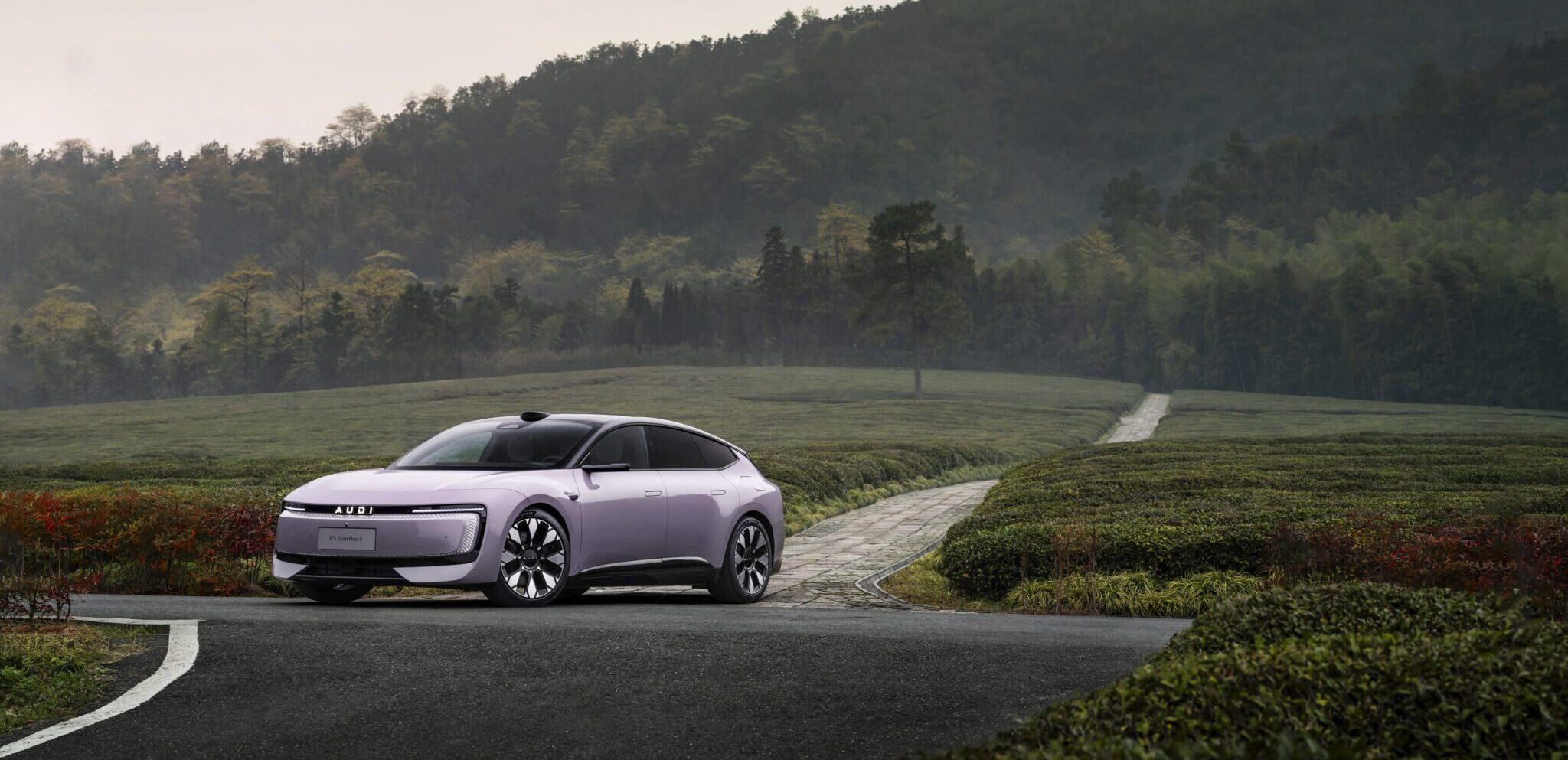
Unfortunately for Audi and SAIC, this strategy has largely fallen flat thus far. The E5 Sportback, launched in August 2025 as the ringless marque’s debut model, sold just 7,070 units in its first few months and managed just 605 in January 2026. This struggle out of the gate prompted emergency discounts of CN¥30,000 (US$4,350) to bring the entry price down to CN¥205,900. The model won the 2025 China Car of the Year award, suggesting positive critical reception, but early buyers reported software bugs, an air conditioning system prone to issues, and an ADAS suite too sluggish to be genuinely useful in urban traffic.
A faster-charging competitor from SAIC’s own IM Motors joint venture added an unfavourable comparison that Audi has been unable to escape. The German automaker has since reshuffled its local leadership, making it the third German premium brand to have done so this year after BMW and Mercedes-Benz. The broad challenges facing all three are the same: a fairly rapid decline in local sales due to fierce competition from domestic players.
This trend has acutely affected premium Western brands, but the effects are being felt across the Chinese vehicle market. Native brands took roughly two-thirds of domestic retail car sales in China in 2025, up from under 40% five years earlier. Audi’s overall China sales fell 5% last year to 617,514 vehicles; fully electric sales dropped 44%.
The deepened SAIC agreement is effectively Audi’s response to that pressure—more models, more local development capacity, and a closer integration with a Chinese partner that brings supply chain speed and platform technology the German side cannot generate at comparable cost or pace.
Whether doubling down for a second offensive yields better results than the rather weak opening salvo may depend on just how well the new R&D hub in Shanghai can address the software and feature quality gaps the E5 Sportback exposed. It remains an open question whether Audi—stripped of its most distinctive asset—can actually recover sufficient brand awareness among the younger Chinese buyers it needs before they settle permanently on domestic alternatives.
E-Mobility,Markets,News,OEMs,Software-Defined Vehicle,Stewart Burnett,Volkswagen GroupStewart Burnett,Volkswagen Group#Audi #SAIC #deepen #ties #models #RampD #hub1776667874

More Stories
Pony.ai, CATL partner on first L4 electric light truck
UK lays regulations for automated passenger services
Leapmotor reveals China-only B05 Ultra at Beijing show