





Every customer who walks into a dealership is sending signals, but are you listening? Learning to read your customers and meet them where they are can build trust and close more deals.
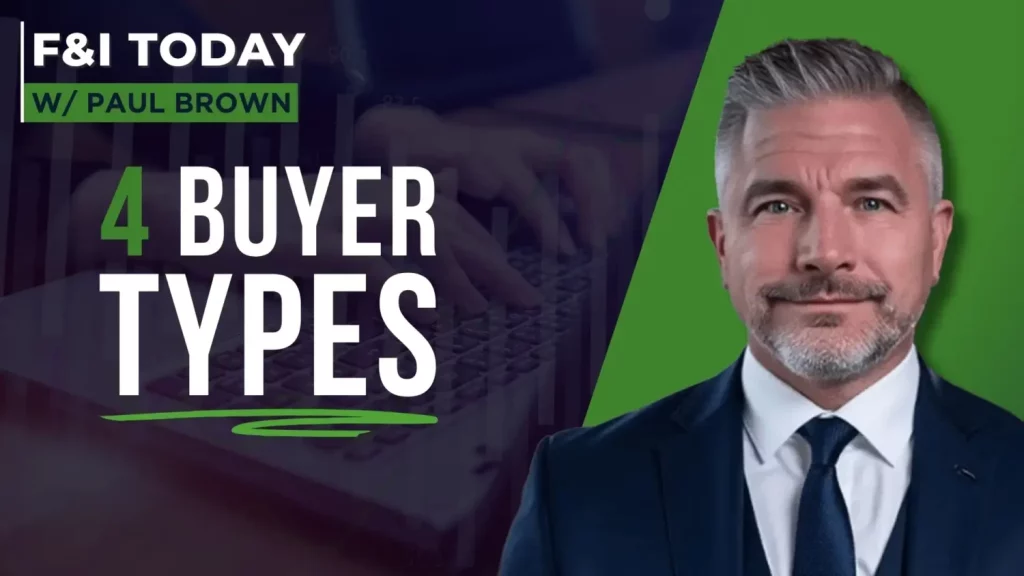
On this episode of F&I Today, Paul Brown, Vice President of Ascent Dealer Services, explains how identifying a customer’s personality type can drive sales success. We all know the Golden Rule: treat others as you want to be treated, but Brown says we should change that to “treat others the way they want to be treated.”
The four main personality types
Most customers fit into four main personality types, Brown says. He’s matched those types with well-known actors to help you identify them and learn how to work with them.
- Type A: the aggressive, results-driven “Robert De Niro.”
- Type B: the fun-loving, rapport-hungry “Jim Carrey.”
- Type C: The analytical, data-driven scientist “Jeff Goldbloom.”
- Type D: The trusting, relationship-first “Owen Wilson.”
Sign up for CBT News’ daily newsletter and get the latest industry stories delivered straight to your inbox.
Type A: Down to business
The Type A or “Robert De Niro” customer is all about business. Brown says any F&I manager who doesn’t spot this type quickly is already losing ground. These are the CEOs, entrepreneurs, and upper-management types who walk in, ready to make a deal and move on.
They lean forward, speak in declarative sentences, and will often cross into your personal space on purpose. Brown says they aren’t being rude, they are asserting dominance.
“It’s about not only the things that we say and when we say them, but more importantly, how we say them that allows us to communicate better with the different personality types.”
With these customers, trying to build a rapport can be a mistake, Brown says. Asking personal questions and making small talk slows the process and loses the customer quickly.
If you have a Type A in your office, get to the numbers, frame every product as a financial investment, and skip the storytelling. Most importantly, let them “win.”
“They need to feel like they’ve won from you in order to buy from you,” he says.
It can be a small concession on price, a deductible adjustment, or a minor give on payment, but give them something, he says. For this customer, Brown says, every transaction lands in either the “win” column or the “lose” column.
Type B: Here to have fun
The Type B or “Jim Carrey” customer wants to have fun, and if you let them, they will buy just about anything.
Brown says the key to selling them is to simply match their energy and get out of the way. These customers are the loud, colorful, enthusiastic types who turn a car purchase into a party.
You can’t treat these customers the same way you would a type A. The mistake most salespeople make with a Type B, Brown says, is rushing to business. Instead, you should lean back, ask about their hobbies, tell a story, and let the room breathe. These customers don’t respond to hard numbers or pressure; they respond to people, so have fun.
“If they’re having fun, they’ll buy the products,” Brown says. “They just want to feel comfortable with you as a person.”
Type C: The data-armed “scientist”
The Type C or “Jeff Goldbloom” customer already knows the numbers. Your job is to confirm what they already suspect, Brown says.
These are the analytical types who walk in with a notebook, an iPad, and a spreadsheet’s worth of research already done. They have done the math, they know the range. Salespeople who run away from this type are making a mistake, Brown says.
Brown says these customers are easy to misread. They sit back, cross their legs, go quiet, and look disengaged. But that’s not the case, Brown says their silence is part of their process.
“They’re doing all the math in their head and running through all the scenarios,” he says, “to see if this truly fits the ownership experience that they’re looking to have.”
Resist the urge to fill the silence, Brown says. Let the math do the talking. Present the numbers, show the value, and when you ask the closing question, stop talking. If you give them the equation and give them space, most of the time they will give you the sale.
Type D: The shy trust-seeker
The type D or “Owen Wilson” customer isn’t buying a product; they are buying a person. Brown says you earn their business with genuine trust.
These are the quiet, but open types who will sit across from you and talk about their lives for several minutes before any paperwork ever comes out. They want to get to know you, and they need to like you. If anything you say feels even slightly off, they are gone, and you may never know why.
“They won’t ever give you a real objection,” he says. “They’ll continue to say no, and you’ll leave that transaction not realizing where you went wrong.”
Selling a Type D means slowing down, telling your story, and letting them tell theirs. These customers have been burned before, and they walk with their guard up. If you can win their trust with patience and consistency, Brown says, the sale will take care of itself.
Practice makes perfect
Learning to identify personality types takes time and practice, Brown says. But don’t get discouraged, the more you use it, the faster the read becomes, and the faster the read, the better every conversation goes.
Personality type awareness is not a closing trick but a communication philosophy that extends beyond the dealership.
“If we engage with people the way that they want to be engaged with,” Brown says, “everything’s better.”
Dealerships that build it into their culture, from the sales floor to the finance office to the desk, will see the difference in both their numbers and their CSI scores.
F&I Today,F&I,Featured,automotive industry news,psychology-based sales,auto industry news,sales tactics,automotive news,dealership news,automotive industry#customer #personality #types #win #business #time1777546530


More Stories
Ford raises 2026 outlook after Q1 earnings beat expectations
Fed holds rates steady, squeezing used-car buyers
The hidden sales killer most professionals don’t even notice