

Musk framed the Terafab project as a bid for vertical integration and supply independence, but in reality it is leaning heavily on Intel. By Stewart Burnett
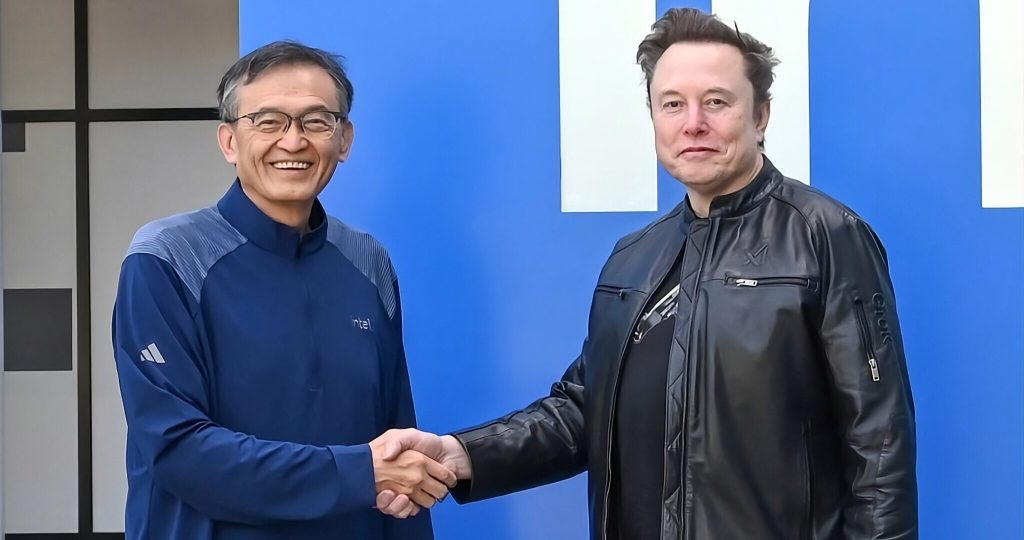
Intel has announced it will join the Terafab project alongside SpaceX, Tesla, and xAI, committing to design, fabricate, and package chips for the US$25bn facility planned for Austin, Texas. Intel Chief Executive Lip-Bu Tan met Elon Musk at Intel’s campus over the weekend, effectively reframing original expectations that the project would be heavily independent.
When Musk unveiled the project in March, the presentation implied that Tesla and SpaceX would stand up a vertically integrated chip manufacturing operation—encompassing lithography, fabrication, memory, and advanced packaging. In other words, Terafab would function as the latest expression of the first-principles engineering that characterised Tesla’s battery and powertrain development.
Intel’s statement that its own capabilities in design, fabrication, and packaging will “help accelerate” Terafab’s goals is arguably less a supplier announcement than an acknowledgement of who will actually run the plant. It should be of little surprise that this will be the case: after all Tesla has never produced a wafer, while Intel has been doing it for decades.
At the time of the announcement, the Terafab project appeared onerous given Tesla’s lack of expertise. Leading-edge semiconductor fabs, which Terafab very much intends to be, require ten or more years and upward of US$20bn to establish, along with manufacturing expertise that cannot be assembled quickly from scratch. The automaker had previously announced US$20bn in capex spending for 2026 to fund its strategic pivot into chips, AI, humanoid robots and robotaxis; Terafab spending only constitutes a portion of this sum.
Intel’s 18A process node, at approximately 1.8 nm, ranks among the most advanced in volume production today, and its packaging capabilities are widely regarded as world-class. What Tesla, SpaceX, and xAI are bringing to the table, then, is demand, capital, and the political alignment that comes from building AI infrastructure on US soil with apparent support from the Biden-era CHIPS Act.
For Intel, the partnership is the most significant validation of its foundry strategy since Lip-Bu Tan took the reins in March 2025. Intel Foundry recorded an operating loss of US$10.32bn in 2025 on revenue growth of just 3%, and the unit has been in need of marquee anchor customers to justify its continued capital expenditure. Landing Musk’s entire compute ecosystem—covering autonomous vehicles, humanoid robotics, satellite data centres, and AI—provides exactly the demand signal the foundry business has been trying to generate.
For Tesla, bringing in Intel arguably complicates its strategic pivot. The automaker has existing chip arrangements with Samsung for its AI6 processors and TSMC for AI5, and Terafab was framed unambiguously as a route towards supply independence. Indeed, Musk told investors last month that Tesla “had to” develop its own fab because external partners could not guarantee sufficient volume. Despite the Terafab monicker, what actually appears to be taking shape is a co-anchored Intel Foundry expansion with Tesla and SpaceX AI as guaranteed customers.
To be sure, this approach is far more rational and achievable than the vision Musk had previously outlined. Tesla already has its hands full already navigating reversing vehicle sales, an exodus of senior talent, and the production ramp of two separate unproven products in the Cybercab robotaxi and Optimus humanoid robots.
What emerges, then, is yet another reason Musk’s often-grandiose claims cannot be taken seriously without matching action. In March, the narrative was that Tesla was entering semiconductor manufacturing in the same disruptive spirit it brought to electric vehicles. In April, the reality is that it has secured a foundry partnership with the lone US company boasting the technology to make the project viable. That is a far more defensible decision; it is simply not the one that was announced.
Manufacturing,Markets,News,OEMs,Software-Defined Vehicle,Stewart Burnett,TeslaStewart Burnett,Tesla#Teslas #Terafab #takes #shape #Intel #hard #parts1775645834
More Stories
Pony.ai, CATL partner on first L4 electric light truck
UK lays regulations for automated passenger services
Leapmotor reveals China-only B05 Ultra at Beijing show