




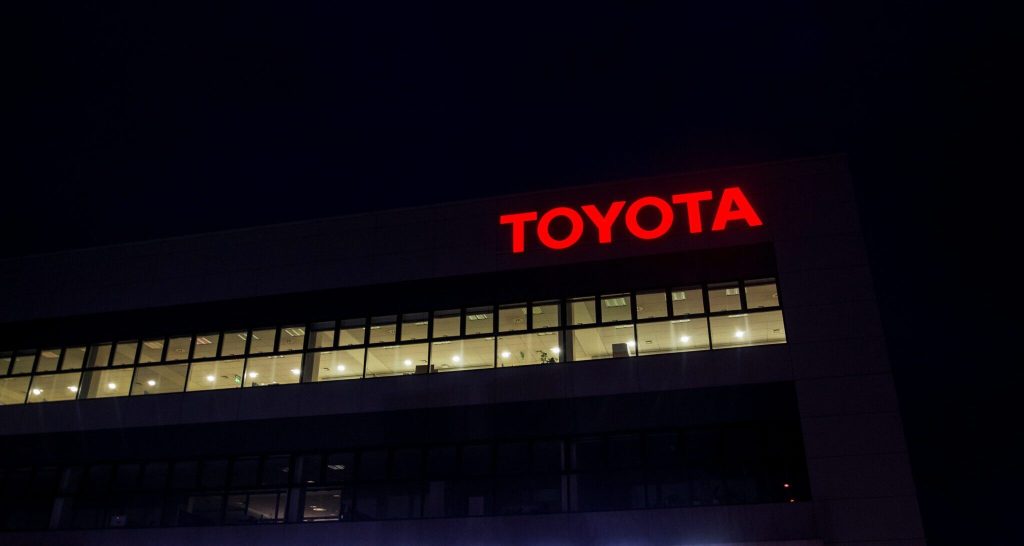
Fears over the Strait of Hormuz have forced Toyota to cut Middle East output by roughly 65% of its normal monthly export volume there. By Stewart Burnett
Toyota will reduce production of vehicles bound for the Middle East by nearly 40,000 units across March and April, according to a Nikkei report citing supplier notifications, as the apparent closure of the Strait of Hormuz disrupts shipping routes to the region. The cuts represent 60% to 70% of Toyota’s estimated monthly export volume to the Middle East.
The reductions are split across two months: 20,000 units in March and a further 18,000 in April. Affected models are expected to include the Land Cruiser and other SUVs, along with sedans and light commercial vehicles—models vehicles built primarily at Japanese plants to be sold in regional markets.
Disruptions caused by uncertainty around the Strait of Hormuz could, however, extend well beyond Toyota’s domestic operations. Pakistani automaker Indus Motor Company, which assembles Toyota vehicles in Pakistan, has warned that escalating tensions around the Strait could delay the supply of imported components and completely knocked-down kits, creating production uncertainty at its own facilities.
Indus’ warning serves as an illustration of how the Hormuz debacle cascades beyond direct shipping exposure. Automakers that do not use directly use the Strait to ship their vehicles are still at high risk of knock-on effects through their component and materials supply chains. The Pakistan case could be the first of many that have to light in the coming weeks and and months.
Beyond Toyota and its regional producers, the wider automotive impact of the US-Israel war against Iran is expected to be substantial. This is in large part due to oil dependency: Japan imports roughly 90% of its crude oil, South Korea approximately 70%, and China—the world’s largest vehicle market—receives 84% of its Gulf-bound crude through the Strait.
All three countries play host to some of the world’s largest vehicle manufacturing bases with significant energy-intensive operations, from steel foundries and aluminium smelters to paint shops and powertrain machining, each of which will face rising input costs.
During its mission to the UN, Iran took pains to reject any accusations of closing the Straight. Instead it is pointing the finger at the US for endangering global maritime security, although it should be noted that various global carriers—among them Hapag-Loyd, Maersk and MSC—have suspended their transits regardless.
Commercial Vehicle,Manufacturing,Markets,News,OEMs,Stewart Burnett,Toyota GroupStewart Burnett,Toyota Group#Toyota #cuts #units #Strait #Hormuz #fears1772800466

More Stories
Pony.ai, CATL partner on first L4 electric light truck
UK lays regulations for automated passenger services
Leapmotor reveals China-only B05 Ultra at Beijing show