
Potentially the strongest market for Tesla’s software revenue is also the one where it cannot yet sell its flagship self-driving system. By Stewart Burnett
Among the many ambitious claims made by Tesla during its Q1 earnings call was that it is working to launch Full Self-Driving (FSD) in the Chinese market “as soon as possible”, without providing a timeline. The China FSD approval has been repeatedly promised and repeatedly delayed; it remains an ongoing point of contention between the automaker and state regulatory bodies.
At Tesla’s November 2025 shareholder meeting, Chief Executive Elon Musk said he expected approval around February or March 2026. He doubled down on that timeline at the World Economic Forum in Davos the following January, despite no apparent progress being made in the intervening time. Of course, the deadline passed and little was said about it. At the time of the Davos summit, state-owned outlet China Daily, citing government sources, issued a firm denial that the February target was realistic.
The statement came around the same time that Musk used his X account to rebuff Ford Chief Executive Jim Farley’s framing of BYD as the primary competitive benchmark for US automakers. Musk appeared to take umbrage at this assertion, highlighting Tesla’s pending FSD approval in China and Shanghai production output as factors Farley may have forgotten to consider.
The path to full FSD regulatory approval has been years in the making. Tesla first established a Shanghai data centre in 2021 to satisfy China’s requirement that vehicle data remains within the country, and it was the first foreign automaker to pass data security requirements from the country’s auto industry body in April 2024. This was enabled in part by a mapping partnership with Baidu, essentially a legal necessity given the restrictions on foreign firms to develop high-definition maps in China.
A local AI training centre also began operating in early 2026, allowing Tesla to train its Chinese neural networks domestically rather than sending data to its US Dojo clusters. But despite all of this progress on infrastructure, the software Tesla has been rolling out in China since February 2025 operates under strict constraints. Following local scrutiny of autonomous driving technology and the accuracy of its marketing, Chinese regulators require SAE Level 2 systems to include the word “assisted” in their branding.
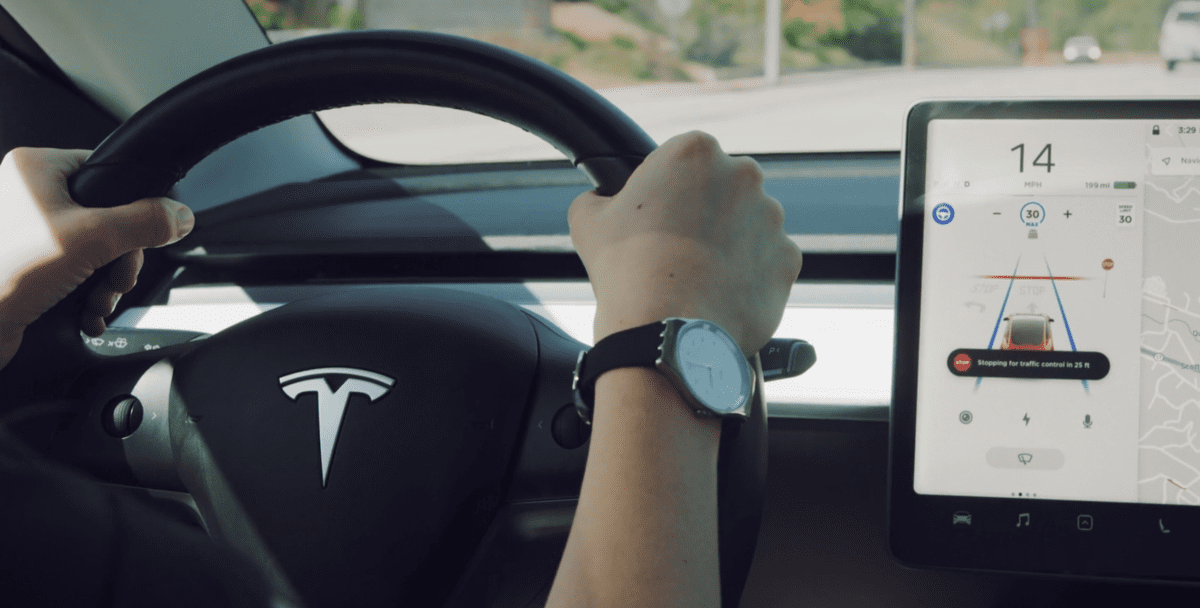
As a result, Tesla’s FSD has been rebranded as Intelligent Assisted Driving in China, with language explicitly framing the human as the primary driver throughout every interaction. The system is running at v13 while North American customers have moved to v14, and it costs approximately CN¥64,000 (US$9,000)—a significant premium against domestic rivals like BYD, Xpeng and Xiaomi, all of which offer comparable urban navigation features either at no additional charge or substantially lower cost.
Musk’s Shanghai reference in the Farley exchange points to Giga Shanghai’s growing centrality. The facility produced more than 85,600 vehicles in March alone and accounted for approximately 60% of Tesla’s global Q1 deliveries. Its product localisation rate now exceeds 95%, with more than 400 Chinese suppliers in the automaker’s local chain. A Tesla China executive recently hinted that the plant could eventually serve as a production site for Optimus humanoid robots; the company subsequently clarified no specific plans exist.
Ultimately, FSD approval in China matters beyond a recurring revenue stream. Tesla’s vehicle sales in China fell by more than 16% year-on-year in Q1, and domestic competitors are iterating on free or low-cost driver-assistance capabilities at a pace that the absence of a fully-approved, fully-featured FSD makes increasingly costly. Musk framed China as a market where his company’s position will likely improve appreciably once FSD receives regulatory approval; whether it can sustain the growing gap between it and competitors is another matter entirely.
Tesla’s parallel efforts to receive full FSD approval in Europe offers little, if any, reassurance on that timeline. FSD Supervised finally received its first European regulatory approval—from the Netherlands—in April, with potential EU-wide clearance being explored through the European Commission. That process is expected to take months.
Meanwhile, China operates a distinct regulatory framework, and two publicly stated timelines have already passed without result. By Musk’s prior statements, there may be little reason to expect a change in the immediate future. In 2025, he characterised the delays as a bargaining chip in the ongoing trade war between the US and China. Little progress has been made on this front in the intervening time, so perhaps there is little reason to expect progress with FSD in the immediate future.
Autonomous Driving,Markets,News,OEMs,Software-Defined Vehicle,Stewart Burnett,TeslaStewart Burnett,Tesla#Tesla #continues #promise #FSD #China #approval #delays1777050186
More Stories
Pony.ai, CATL partner on first L4 electric light truck
UK lays regulations for automated passenger services
Leapmotor reveals China-only B05 Ultra at Beijing show