
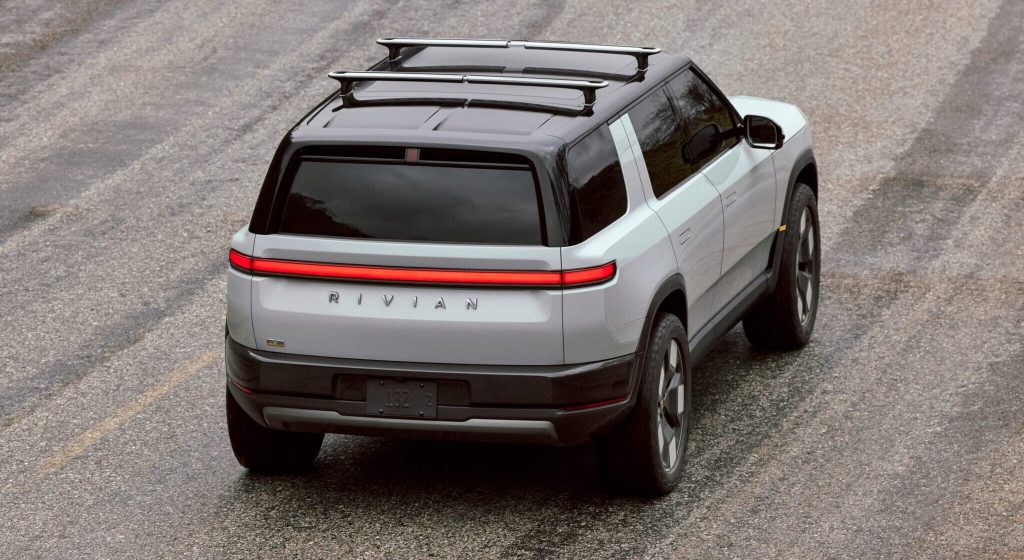
Days after the grand reveal, Rivian locks in a guaranteed sales floor for its highly-anticipated R2 SUV. By Stewart Burnett
Rivian is the latest player to tie up with Uber on robotaxis; the two companies announced a partnership on 19 March to deploy 10,000 fully-autonomous R2 SUVs beginning in 2028. Uber has committed an initial US$300m investment and up to US$1.25bn through 2031 subject to Rivian meeting specific autonomous performance milestones.
Rivian’s shares rose approximately 9% in premarket trading on the news. The automaker noted in a press release that as many as 50,000 robotaxis may be deployed as part of the agreement. Beyond driver-assist functionalities it is new to the territory, having only revealed its first custom self-driving chip in December 2025.
The deal also provides a guaranteed commercial demand floor for the R2 at a moment when Rivian’s consumer pricing strategy is under heavy pressure. Chief Executive RJ Scaringe has repeatedly alluded to the US$45,000-$48,000 price point as the sweet spot for mainstream acceptance of electric vehicles. The R2 will debut later in 2026 exclusively in its most expensive trim, Performance, at a starting price of US$57,990. A US$45,000 variant has been promised for 2027, but no clear timeline or specifications have yet been offered.
The arrangement draws a fairly explicit parallel with Rivian’s commercial van deal with Amazon—a contracted volume anchor that underwrites production scale while the broader consumer base develops. At the time of writing, Amazon has deployed more than 30,000 of Rivian’s vans; as many as 100,000 are planned through 2030.
The R2 robotaxis, as is the case with most Uber tie-ups, will run exclusively on the company’a ride-hailing platform. They will launch first in San Francisco and Miami before expanding to 25 cities across the US, Canada, and Europe by end-2031. The automaker’s third-generation autonomy platform—comprising 11 cameras, five radars, one LiDAR unit, and dual in-house RAP1 chips—will power the robotaxi fleet, with Uber Chief Executive Dara Khosrowshahi citing Rivian’s vertical integration across vehicle, compute, and software as central to the partnership’s appeal.
The capital injection also addresses a specific vulnerability in Rivian’s near-term position. The US$1.25bn, spread across four years, provides runway alongside the Volkswagen joint venture’s US$5.8bn commitment as Rivian completes its R2 production ramp in Normal, Illinois, and continues construction of its Georgia factory. Each incremental tranche is contingent on hitting autonomy milestones, meaning Rivian’s ability to draw down the full amount depends on technical execution it has not yet demonstrated at scale.
Uber’s robotaxi strategy is explicitly platform-agnostic—the company has partnerships with Waymo, Baidu, Zoox, Lucid, and numerous others, and is working with Nvidia on AI and simulation infrastructure for autonomous fleet scaling.
Autonomous Driving,E-Mobility,Markets,News,OEMs,Software-Defined Vehicle,Stewart BurnettStewart Burnett#Rivian #takes #seat #Ubers #robotaxi #umbrella1773941266
More Stories
Pony.ai, CATL partner on first L4 electric light truck
UK lays regulations for automated passenger services
Leapmotor reveals China-only B05 Ultra at Beijing show