




Nio’s swap stations handled 110 replacements per minute at the peak of China’s Lunar New Year festivities. By Stewart Burnett
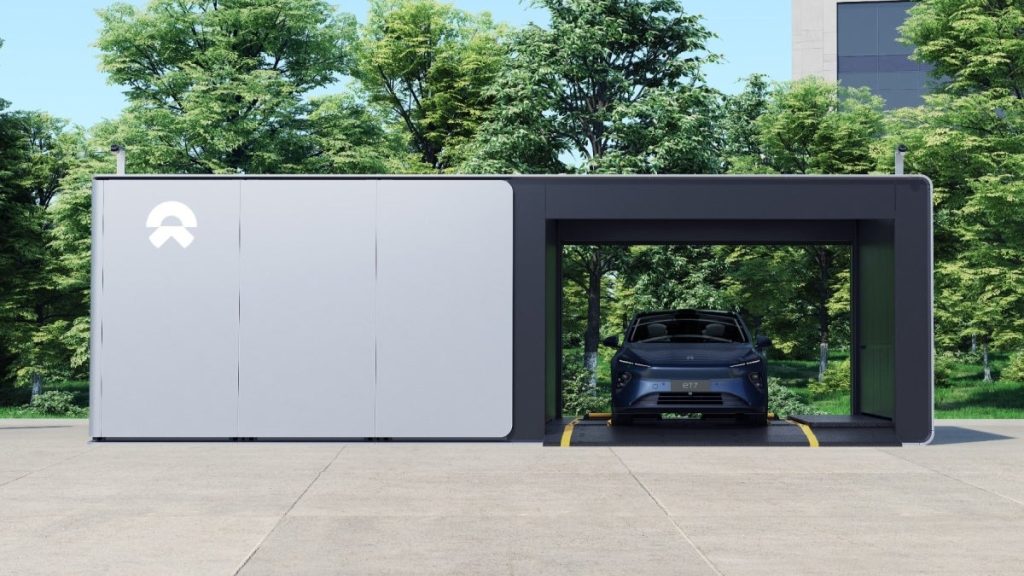
Nio set a new daily battery swap record of 158,290 swaps on 18 February, surpassing the previous all-time high of 146,649 set just three days earlier on the first day of China’s Lunar New Year festivities. The network was processing around 6,595 replacements per hour (roughly 110 per minute) at its peak, with the busiest individual stations located on highways serving intercity travellers.
Nio has increasingly made a habit of posting record swap numbers on national holidays. Indeed, the previous record had itself only just overtaken the 145,395 swaps recorded during last October’s National Day holiday week. The latest milestones come on the heels of Nio’s 100-millionth cumulative swap on 6 February, which the company described as large-scale validation of the battery swap model.
The automaker has thus far invested over CN¥18bn (US$2.5bn) in charging and swap infrastructure over the last 11 years, securing more than 2,100 patents in the process. With the Spring Festival travel rush expected to peak on 22 February—when traffic is projected to reach 71 million vehicles—it remains highly possible that an additional record is set before the festivities wind down on the 23rd.
Nio is preparing to scale the network further. Having fallen short of its 2025 station deployment target after redirecting resources toward a next-generation system, the company plans to build 1,000 new stations in China during 2026 and will begin large-scale construction of its fifth-generation swap stations from March.
Its existing fourth-generation stations, first introduced in 2024, can store up to 23 battery packs and complete a single swap in under three minutes, with a maximum throughput of 480 swaps per day. A pilot version of the fifth-generation format was expected around the end of 2025, though technical details have not yet been disclosed.
Nio currently operates 3,750 swap stations in China—including more than 1,000 on highways—and roughly 60 in Europe, alongside 28,223 charging piles and access to over 1.57 million third-party charging points. The network now supports seven battery capacities across Nio’s three brands, up from two in 2023.
The automaker has signed cooperation agreements with CATL, Changan, Geely, Chery, GAC, FAW and JAC to develop vehicles compatible with its swap infrastructure, a move designed to raise station utilisation and improve the economics of the network. Its main competition in the segment comes from CATL’s Choco-Swap service, which is targeting more than 10,000 stations with a standardised battery format, and Aulton New Energy, an established operator focused on taxis and commercial fleets.
Despite the positive news, the gap between record throughput and the network’s theoretical capacity suggests that Nio’s infrastructure continues to operate well below capacity outside of holiday surges. Whether partnerships with other OEMs can normalise utilisation levels remains to be seen. As it stands, the automaker’s battery-as-a-service model has yet to reach profitability.
E-Mobility,Markets,News,OEMs,Stewart BurnettStewart Burnett#Nio #sets #158k #battery #swap #record #China #Year #rush1771498875



More Stories
Pony.ai, CATL partner on first L4 electric light truck
UK lays regulations for automated passenger services
Leapmotor reveals China-only B05 Ultra at Beijing show