


Autonomous vehicle designed for San Francisco Bay Area debut features next-gen sensors, premium in-cabin experience, and AI-driven safety.
On the Dash:
- Lucid, Nuro, and Uber debuted a production-intent robotaxi at CES 2026, with testing underway in the Bay Area.
- The vehicle features advanced sensors, NVIDIA AI computing, and a premium, customizable in-cabin experience.
- Production is expected at Lucid’s Arizona factory later this year, pending final validation.
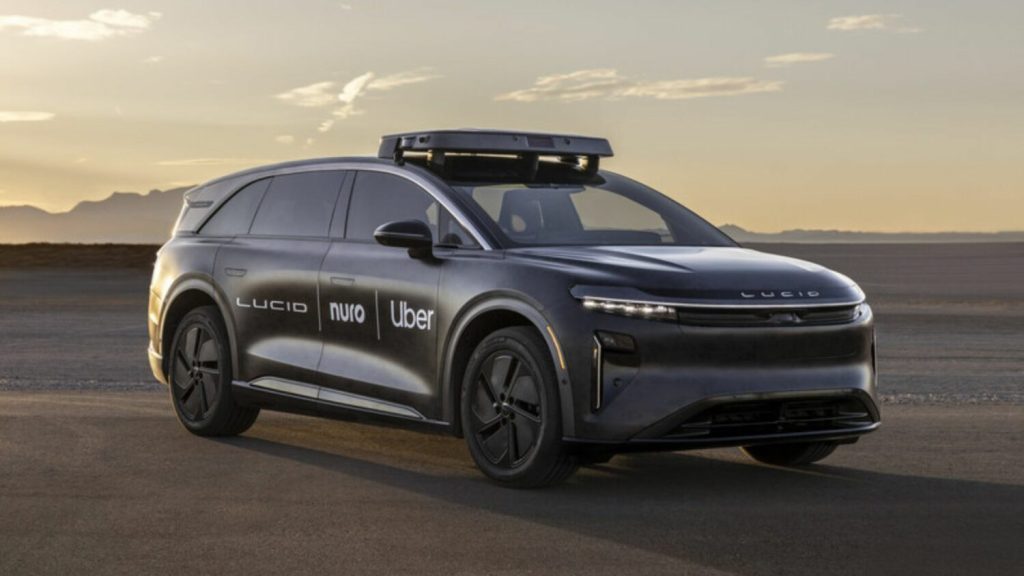
Lucid Group, Nuro, and Uber introduced their production-intent robotaxi and Uber-designed in-cabin rider experience at CES 2026, as autonomous on-road testing begins ahead of a planned San Francisco Bay Area launch later this year.
The vehicle was on public display at NVIDIA’s CES showcase at the Fontainebleau Hotel from Jan. 5 through Jan. 8.
The Lucid Gravity-based robotaxi features a next-generation sensor array, including high-resolution cameras, solid-state lidar, and radars, providing 360-degree perception. A low-profile roof-mounted halo module with integrated LEDs helps riders identify their vehicle and communicates trip status. NVIDIA DRIVE AGX Thor powers AI processing for real-time autonomous driving and system integration.
Sign up for CBT News’ daily newsletter and get the latest industry stories delivered straight to your inbox.
The interior accommodates up to six passengers in a versatile layout with generous luggage space. Riders can personalize their journey using interactive screens to adjust the climate, activate heated seats, play music, request support, or instruct the vehicle to pull over. Additionally, real-time visualizations show what the robotaxi detects on the road and its planned maneuvers.
“This debut is a significant milestone on our path to delivering autonomy at scale,” said Dave Ferguson, co-founder and co-CEO of Nuro, in the company’s press release. “By combining Nuro’s proven level 4 autonomy, Lucid’s advanced vehicle architecture, and Uber’s global reach, we’re building a robotaxi service designed for real-world operations and long-term growth.”
Uber’s Sarfraz Maredia, global head of autonomous mobility and delivery, said the collaboration will create a unique, scalable autonomous ride option for the San Francisco Bay Area and beyond. Notably, Lucid Vice President Kay Stepper highlighted the program’s focus on sustainability and accessibility, leveraging the company’s engineering, range, and interior comfort.
Testing includes on-road, closed-course, and simulation trials to validate the full autonomy stack. Pending final validation, production is expected to begin later this year at Lucid’s Arizona factory.
The robotaxi program marks a key step toward integrating EV technology, autonomous systems, and ride-hailing expertise to deliver a next-generation mobility experience.
EVs & Technology,Articles,Headlines,robotaxis,EV news,Lucid,NVIDIA,uber,car business,Retail Automotive,electric vehicles,auto industry,dealership news#Lucid #Nuro #Uber #debut #productionready #robotaxi #CES1768233527
More Stories
Weekly roundup: FTC wants dealers to report deceptive pricing, Ford boost U.S. assembly, Carvana expands dealership portfolio
Autonomous future back in focus as Waymo expands, Uber reinvests billions
New car sales drop 7.3% in April, but don’t blame buyers