




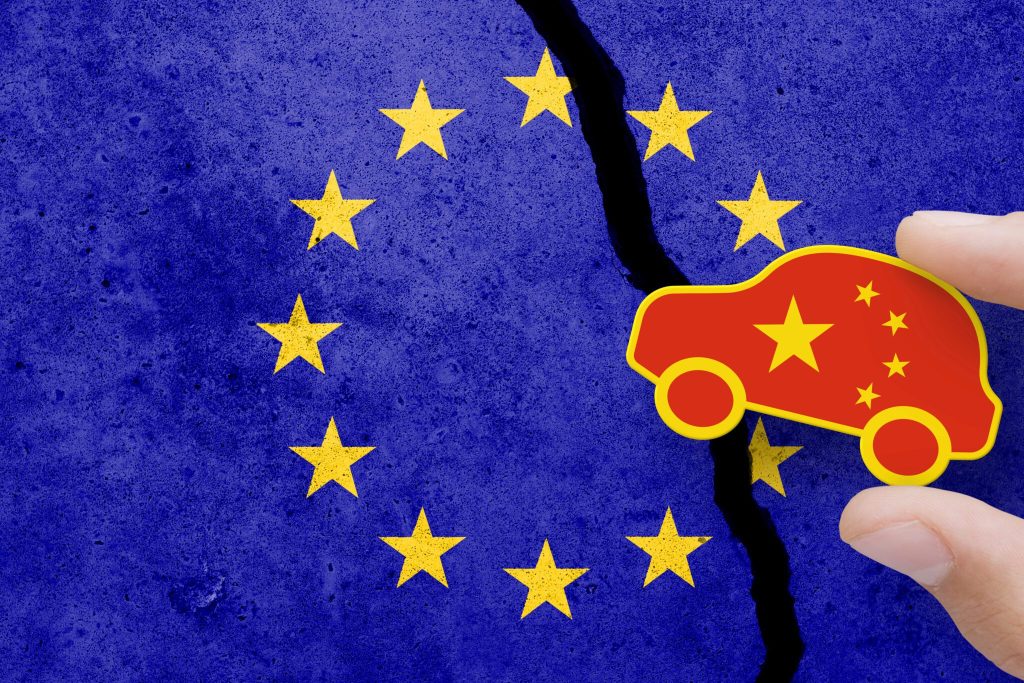
China has condemned the EU’s Industrial Accelerator Act as protectionist, warning it will monitor the legislation and defend its companies’ interests. By Stewart Burnett
In an effort to protect embattled local manufacturing operations, the European Commission’s Industrial Accelerator Act las laid out “Made in Europe” procurement preferences and new investment conditions for batteries, electric vehicles (EVs), solar panels, and critical raw materials. This naturally incensed China’s Commerce Ministry, which quickly responded by labelling the measures as “serious investment barriers and institutional discrimination” that violate World Trade Organization principles.
The act targets companies from countries holding more than 40% of global manufacturing capacity in a given sector—a threshold that makes little attempt not to point towards China. Such companies must employ at least 50% EU nationals in their domestic manufacturing operations, keep foreign ownership below 49%, and channel 1% of their global revenue into EU research and development.
EVs, arguably China’s most prominent global export save perhaps for EV batteries, face a 70% EU-content requirement for procurement eligibility, although most battery components are exempted. However, that carve-out perhaps better reflects the continent’s reliance on Korean and Japanese battery producers moreso than their Chinese counterparts. Japanese and Korean battery makers together account for the majority of Europe’s installed capacity.
Little surprise, then, that the Commission is trying to be as accommodating as possible toward these countries. Indeed, all nations with EU free trade agreements—estimated at up to 40 nations including the UK, South Korea, and Japan qualify for EU-origin status under the proposal. That broadens the act’s effective perimeter well beyond the EU27, and excludes both China and the US, neither of which holds a comprehensive FTA with the bloc.
The proposal must pass muster with both the European Parliament and all 27 EU member states, a process expected to take one to two years. Internal divisions have already shaped the text: France pushed for harder protectionism, Germany sought inclusion of supply chain partners, and Nordic and Baltic states warned excessive restrictions would deter investment.
Hungary, known for its more sympathetic attitude towards the Chinese and Russian governments, has voiced staunch opposition. The country, led by Viktor Orban since 2010, is trying to position itself as a hub for Chinese automakers trying to establish a foothold in Europe. Both BYD’s regional headquarters and first major local manufacturing facility are located in the country, the latter commencing scale production in mid-2026.
The act arrives as the European automotive sector has shed 200,000 jobs since 2024, with 600,000 further losses projected in vehicle production alone as the decade progresses. Brussels is framing it as a structural intervention to anchor industrial capacity before further erosion makes the position unrecoverable.
E-Mobility,Manufacturing,Markets,News,Stewart BurnettStewart Burnett#EUs #Europe #plan #draws #sharp #rebuke #China1772816541


More Stories
Pony.ai, CATL partner on first L4 electric light truck
UK lays regulations for automated passenger services
Leapmotor reveals China-only B05 Ultra at Beijing show