




What should other players take from China’s playbook, and what should they leave? By Megan Lampinen
China’s automotive industry has radically reinvented itself over the past decade. The market that was once a byword for cheap copycats now sets the bar in terms of high-tech engineering efficiency, and everyone is suddenly scrambling for ‘China speed.’
What does ‘China speed’ look like?
The term refers to the pace at which innovation is developed and brought to market. Pinning that down into a single metric isn’t straightforward, but vehicle development cycles offer one indication. Formerly running to six or seven years, Chinese brands have slashed these to as short as 18 months. As a result, the cadence of new vehicle launches is accelerating.
Arthur D Little data estimates that Chinese brands launched 388 new passenger car models (both new and refitted designs) on the market between 2023 and 2025. Veteran car analyst Felipe Muñoz offers slightly different data points for global comparisons. During calendar 2025, the top 19 Chinese OEMs revealed 87 all-new vehicles, excluding facelifts or mid-cycle refreshes, equating to 4.6 new vehicles per company. In comparison, Japanese brands presented 34 new models, European brands 28, Americans 12, and Koreans nine. “The Chinese are simply the fastest when it comes to making new cars and presenting new solutions,” Muñoz tells Automotive World.
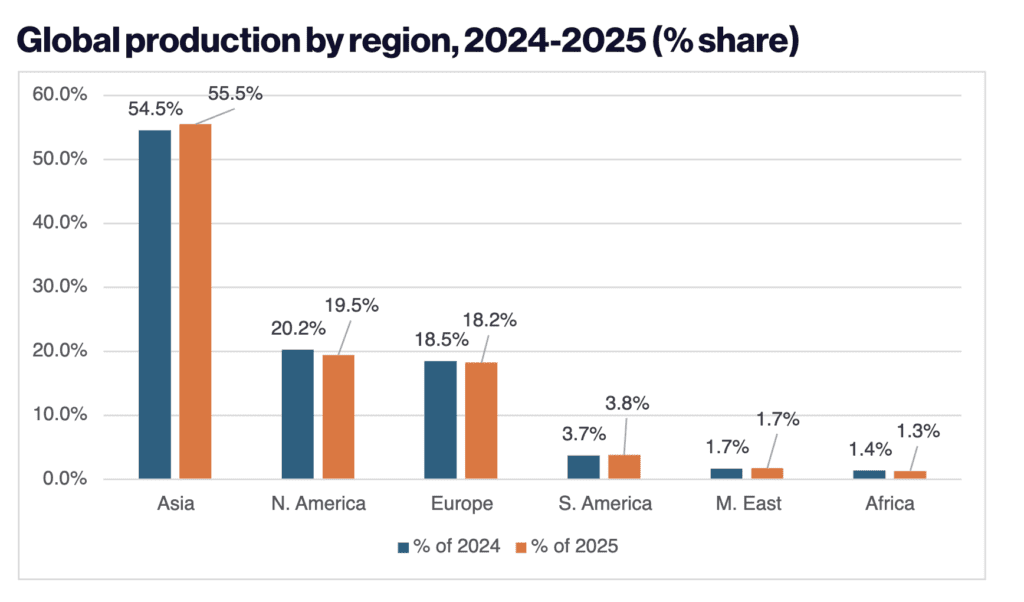
Overall production volumes are up as well. Automotive World data shows that China alone accounted for 29% of all new vehicles produced in 2025. In comparison, the entirety of North America contributed 19.5% and all of Europe 18.2%. Notably, more than half (53%) of the cars sold in China in 2025 were electric or plug-in hybrid.
What can be transferred?
Since COVID, it has become abundantly clear that there are lessons here to be learned. “Anyone in the auto industry who didn’t feel like something was going to happen in China five years ago was fooling themselves,” Ford Chief Executive Jim Farley told Car and Driver. “Certainly, I felt that way. But did we know that the companies and the local brands would get that good that fast? No way.”
But matching China’s cadence isn’t a case of copy and paste. “Not all elements of ‘China speed’ can be copied,” observes Niklas Brundin, Partner at Arthur D Little. “Scale, customer demographics, and the policy environment are specific to China. What is transferable is the way Chinese OEMs organise for speed: flatter organisational structures, faster development cycles, stronger customer co-creation, and selective vertical integration.”
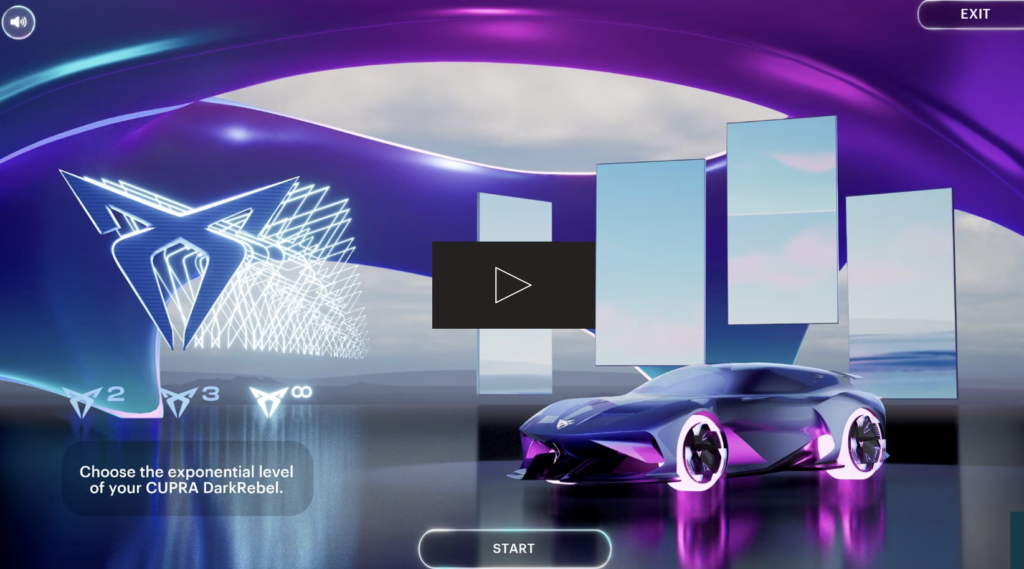
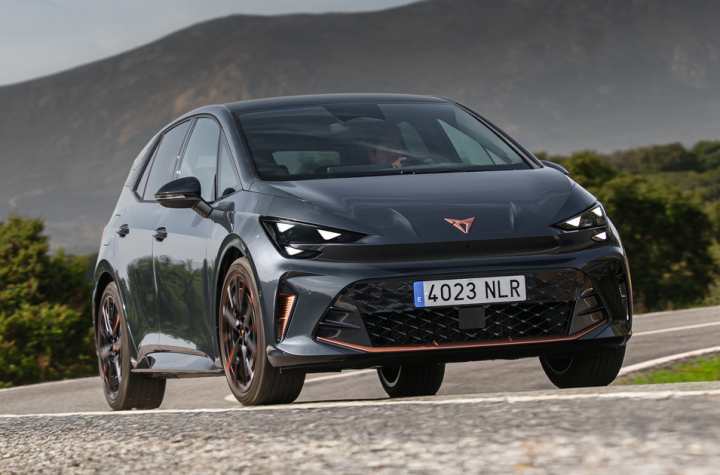
Customer co-creation is increasingly pivotal to the Chinese players. Nio has regional teams in China and Europe dedicated to analysing driver feedback from various sources, including the Nio app, in-person user events and the AI digital assistant Nomi. In China, the company hears from more than 300 users every day. Feedback is initially aggregated by AI and passed on to the user-experience teams, which translate it into clear product definitions and potentially future over-the-air updates or model design changes. Among Western brands, Volkswagen Group’s Cupra has embraced the concept of customer co-creation, drawing more than 270,000 fan design suggestions via its Metaverse platform, Metahype. The crowd-sourced design took form in the DarkRebel concept car.
As for development cycles, Brundin suggests that governance, rather than functions, is where the biggest opportunity lies for Western OEMs to streamline. “Committee-heavy decision making and layered approvals slow execution,” he points out. In terms of concrete steps to address this, Arthur D Little’s January 2026 China Speed report suggests simplifying forums, clarifying accountability, and shortening the distance from decision to implementation.
When it comes to vertical integration, Chinese OEMs are demonstrating the benefits of developing core software in-house. This helps with faster iteration as well as tighter overall hardware-software integration and less dependence on suppliers. For Western OEMs, Arthur D Little suggests a selective approach of insourcing critical software where speed matters most, while partnering where scale, talent, or capital constraints make full in-house development inefficient.
What shouldn’t be transferred?
But not everything practised in China can or should be duplicated elsewhere, such as the infamous ‘996’ working week: 9am to 9pm, six days a week. Arthur D Little specifically cautions against trying to transplant extreme work intensity or employment models directly into Western contexts without adaptation.
Then there is the proliferation of brands. China’s total count constantly fluctuates but is currently hovering around 100 local brands, many of which fall under the same parent company. Geely’s portfolio, for example, includes not just the Geely Auto brand but also Geometry, Radar, Volvo Cars, Polestar, Zeekr, Lynk & Co, Lotus, LEVC, Proton, and a joint venture with Smart.
“Many Chinese players are still introducing new brands, and sooner or later it will play against them,” cautions Muñoz. “This is something that Western brands should not copy. They should have already learned this lesson.” And some did. General Motors had a dozen different brands at its peak, which eventually became unsustainable. The company conducted a major pruning following its 2009 bankruptcy, which has left it with four core brands today, as well as stakes in a couple of others.
Preserving unique strategic advantages
Whether it’s investing in a local presence or teaming with Chinese players, Brundin warns that those who don’t tap into local knowledge risk losing access to pivotal market insights, leading-edge technology and an increasingly important engineering talent pool. The message has been received.
Volkswagen is now aiming to shrink its development cycle in China by 30% to a maximum of 34 months in a bid to launch more than 30 new models by the end of 2027. It has also allocated billions towards an ‘In China, for China’ R&D strategy to accelerate local innovation while simultaneously working with Chinese technology leaders, such as Xpeng, for software and electrification.
Renault is reportedly pushing for an EV development cycle of just 16 months by leveraging its Shanghai tech centre. Toyota specifically referenced ‘Shanghai speed’ as the force behind the rapid development of its upcoming Shanghai Lexus plant, where it made a point of tapping local talent.
While the changes sweeping through the industry require adaptation and evolution, Western automakers will do well to remember their own strategic advantages of brand heritage, home-market positions, and manufacturing scale. It’s not that these are without value; rather, they are no longer sufficient on their own, and should be complemented with faster innovation cycles, greater vertical integration, stronger software capabilities, and closer customer collaboration.
Articles,E-Mobility,Manufacturing,Markets,OEMs,Megan LampinenMegan Lampinen#China #speed #isnt #cutandpaste #model1773734380

More Stories
Pony.ai, CATL partner on first L4 electric light truck
UK lays regulations for automated passenger services
Leapmotor reveals China-only B05 Ultra at Beijing show