




Xiaomi again finds itself at the centre of a national debate about the safety of the technology it uses. By Stewart Burnett
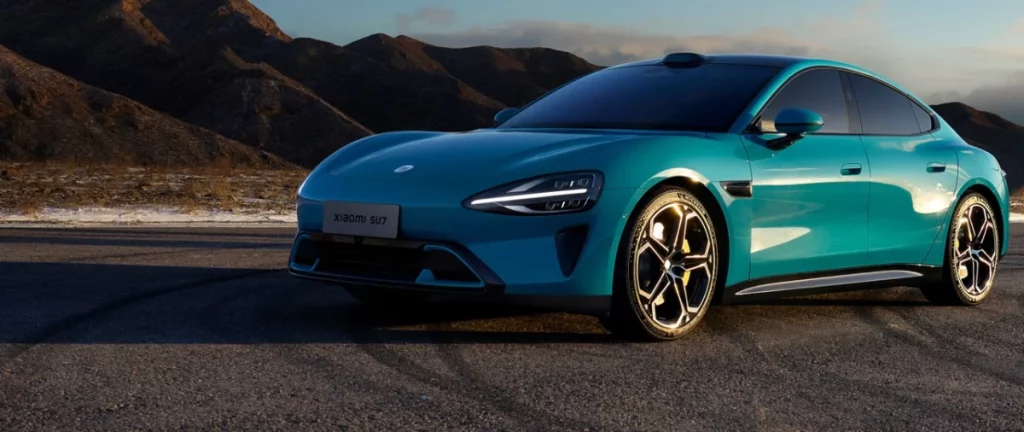
A judicial appraisal of a fatal crash involving a Xiaomi SU7 in Chengdu on 13 October 2025 has confirmed that the vehicle’s doors could not be opened from the outside after impact severed the low-voltage system controlling its electronic door releases. The driver died from severe burns after the vehicle caught fire.
The forensic report, obtained by Chinese outlet Caixin, found that the collision triggered a short circuit in the high-voltage battery, sending abnormal current into the low-voltage circuit and disabling the exterior door handle release. The SU7 has no external mechanical emergency handle; its manual release is located in a storage compartment inside the door, requiring a rescuer to extend an arm fully through the vehicle to reach it.
Bystanders who attempted to free the driver were unable to open the doors, with at least one breaking a window and reaching inside to find the interior handle also unresponsive. Authorities did find the driver fully at fault for the crash itself; he was suspected of drunk driving and was travelling at 167 km/h at impact.
The findings add some heft to a regulatory action the Chinese government had already set in motion. In January 2026, the Ministry of Industry and Information Technology published mandatory new standards requiring mechanical releases on both the interior and exterior of all vehicle doors, operable without power and following both collision and battery thermal runaway events.
The new rules are supposed to take effect from January 2027 for newly approved models and January 2029 for existing ones. Xiaomi has confirmed that production of the first-generation SU7 has ended and that an updated model launching later in 2026 will comply with the new standards.

China’s regulatory move is likely to reshape electric vehicle door design well beyond its own borders. The flush pop-out handle, introduced on Tesla’s Model S in 2012 and since adopted across roughly 60% of China’s bestselling new energy vehicles, is now effectively banned in the world’s largest car market—in practice, this would make it difficult to justify for models sold globally.
In the US, legislative pressure is building too: the SAFE Exit Act, introduced to Congress in January 2026, would impose similar requirements on vehicles sold domestically, while the NHTSA has an open probe into Tesla’s door handle technology following incidents in which power loss trapped occupants after crashes.
Unfortunately for Xiaomi, this is not the first time a crash involving one of its vehicles has placed it at the centre of a national safety debate. In March 2025, a Xiaomi SU7 travelling in advanced driver-assist mode (ADAS) struck a concrete barrier on a highway in Anhui province and caught fire, killing three passengers.
Questions over whether the company’s ADAS had failed to detect an obstacle—and again whether door handle design had impeded rescue—prompted Xiaomi to recall over 117,000 SU7 vehicles to improve the safety of its software, and accelerated a broader regulatory crackdown on how automakers market semi-autonomous technology in China.
Within months, Chinese regulators were moving to ban the use of terms such as “smart driving” and “autonomous driving” in advertising, and by June the MIIT had published draft mandatory safety standards for driver assistance systems. The pattern is one Xiaomi would no doubt prefer to avoid: a company that has built a formidable reputation in consumer electronics finding its automotive ambitions repeatedly tested by incidents that become flashpoints for wider industry reckoning.
E-Mobility,Markets,News,OEMs,Software-Defined Vehicle,Stewart BurnettStewart Burnett#China #probe #finds #door #tech #failed #fatal #Xiaomi #crash1772125594


More Stories
Pony.ai, CATL partner on first L4 electric light truck
UK lays regulations for automated passenger services
Leapmotor reveals China-only B05 Ultra at Beijing show