




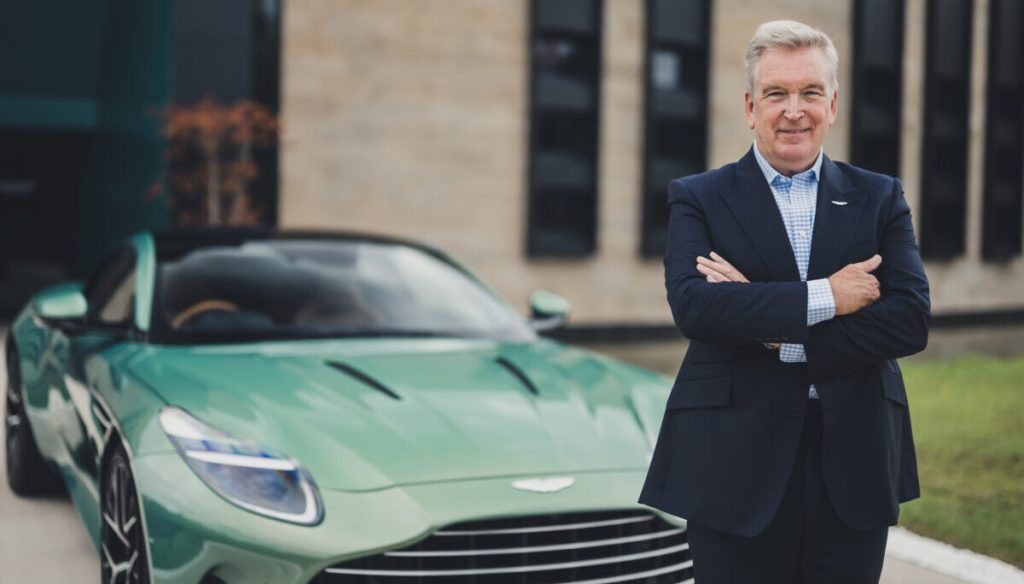
Aston Martin will cut 20% of its workforce as the premium British automaker tries to stem losses that widened significantly last year. By Stewart Burnett
Aston Martin is to cut up to 600 jobs, roughly 20% of its global workforce, as it attempts to contain losses that widened sharply in 2025. The redundancies are expected to deliver annual savings of around £40m (US$50m), with the majority of roles affected based in the UK.
The company reported revenue of US$1.59bn in 2025, down 21% year on year, and posted a net loss of approximately US$666m. Chief Executive Adrian Hallmark attributed the performance to US tariffs, which he described as “extremely disruptive”, and demand in China that had been “extremely subdued”. To conserve its remaining cash reserves, Aston Martin has also cut its five-year capital expenditure plan from £2bn to just £1.7bn, deferring the launch of its first fully electric model into the 2030s.
To be sure, Aston Martin is far from the first Western supercar brand to rein in or abandon its electrification plans. Just last week it was reported that the Volkswagen-owned Lamborghini—also struggling with sales decline—has cancelled its highly-anticipated debut EV, Lanzador, which was originally set for a 2029 market entry.
For Aston Martin, the course correction plan involves some fairly drastic—and creative—measures. For example, a £50m cash injection has been secured through the sale of the Formula One team’s naming rights back to the road car business. The F1 operation, a separate entity, sold the rights to AMR GP Holdings—a company indirectly controlled by Executive Chairman Lawrence Stroll. The move is pending shareholder approval from investors including Mercedes-Benz and Geely. Hallmark characterised the deal as “supportive and not an exit strategy at all,” though some investors have been unsettled by its structure.

The current difficulties cap a prolonged period of financial strain for the premium British marque. When Stroll led a £536m rescue investment in 2020—taking the Executive Chairman role in the process, and bringing in backers including the Saudi Public Investment Fund and Geely—the expectation was that fresh capital and a refocused product strategy would return the Aston Martin brand to health. Revenues grew to £1.63bn in 2023 as the DB12 launched to strong reviews and average selling prices hit record levels, offering a brief indication that the strategy was taking hold.
That momentum, unfortunately, did not last. Supply chain disruptions and engineering delays pushed back deliveries of the high-margin Valhalla hybrid and Valiant specials, both of them cars the company depends on for cash generation. Five profit warnings followed in the space of just 18 months, and by the end of 2025 Aston Martin’s debt pile had risen to approximately £1.4bn, carrying double-digit interest rates that consumed a significant share of its operating income. A smaller round of job cuts representing around 5% of the workforce had already been carried out earlier in 2025.
Hallmark, who took the Chief Executive role in late 2023, has sought to reframe the strategy around fewer, more profitable cars rather than volume growth. Electrification plans have been scaled back in favour of high-margin internal combustion models, and the company’s bespoke Q division—where individual commissions can approach seven figures—is being positioned as a primary earnings driver. Management has set a target of reaching positive free cash flow in the second half of 2026, a goal that depends heavily on ramping up Valhalla deliveries and the reception of the forthcoming Vanquish V12.
Manufacturing,Markets,News,OEMs,Stewart BurnettStewart Burnett#Aston #Martin #cuts #jobs #capex #losses #mount1772116115


More Stories
Pony.ai, CATL partner on first L4 electric light truck
UK lays regulations for automated passenger services
Leapmotor reveals China-only B05 Ultra at Beijing show