





Caocao believes cost pressures, not capabilities, will be the determining factor in which autonomous driving players survive to 2030. By Stewart Burnett
Geely’s ride-hailing arm Caocao has announced plans to deploy thousands of purpose-built robotaxis globally from 2027, with large-scale fleet expansion expected to reach 100,000 vehicles by 2030. Chief Executive Gong Xin unveiled the company’s robotaxi strategy at this year’s Beijing auto show, positioning Caocao as a direct response to Tesla’s Cybercab—offering China’s first ‘purpose-built’ robotaxi—as well as domestic competitors like Pony.ai and Apollo Go.
The vehicle at the centre of the plan, the Eva Cab, is designed from the ground up for driverless ride-hailing rather than adapted from an existing model. Geely stripped out enclosed door pockets and simplified the cabin to reduce maintenance costs and the risk of passengers leaving belongings behind—a design discipline Gong said would allow the vehicle to be priced below a standard private car. Like Tesla’s Cybercab, it also lacks manual controls.
Caocao’s purpose-built approach is intended, in part, to address a cost ceiling that has weighed on the profitability of other players operating today. Essentially, a modified mass-market car is more expensive to adapt, and comes with multiple unnecessary cost-adding components, than a model built from scratch.
Most incumbents in the still-young robotaxi segment competitors are adapting or retrofitting existing consumer-oriented platforms rather than taking the blank-slate approach. Xpeng’s robotaxi plans, for example, are built around the GX—a flagship SUV with steering controls that can retract for driverless fleet operation. Pony.ai takes the further step of integrating autonomous hardware onto the Toyota bZ4X at the factory level rather than retrofitting it post-production. Still, both approaches are bound by cabins designed with the presence of a human driver in mind.
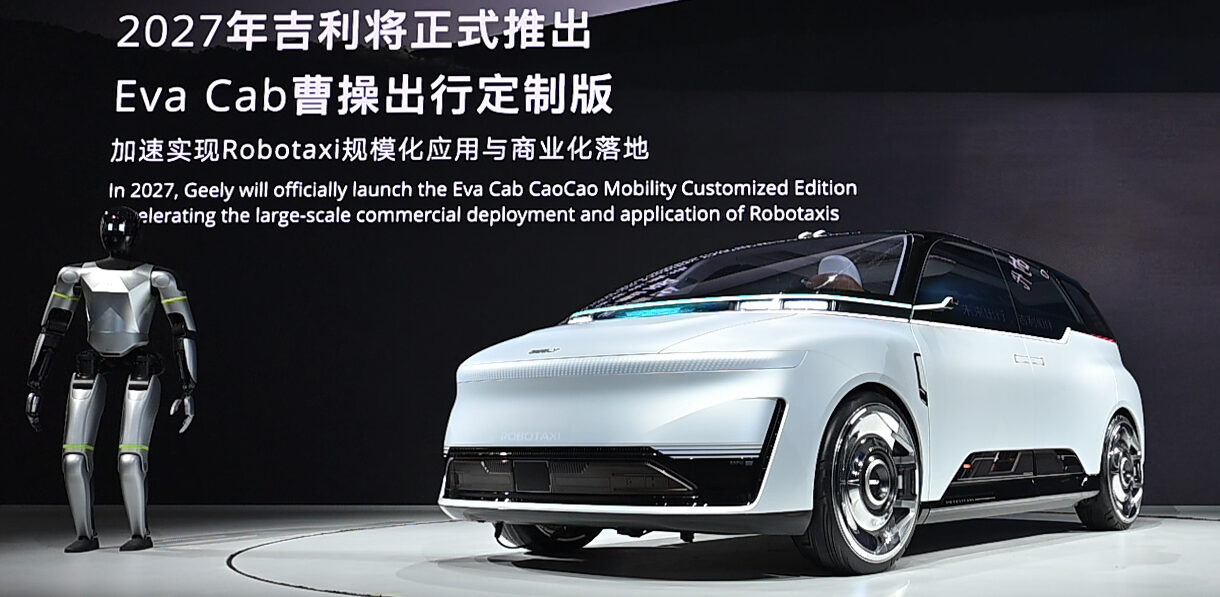
Initial Eva Cab deployments are planned for Abu Dhabi, Hong Kong, and five mainland Chinese cities, with production, delivery, and deployment expected to run almost simultaneously. Caocao already operates a 100-vehicle robotaxi fleet in Hangzhou, where it became the first company to be cleared for driverless road tests without safety drivers in April 2026.
Caocao listed on the Hong Kong stock exchange in June 2025 and recorded its first quarterly adjusted net profit in the fourth quarter of that year. At the time of writing, it operates China’s second-largest ride-hailing platform after Didi, an existing network Gong described as a competitive foundation for the company’s international expansion. Xpeng is pursuing a parallel course, with President Brian Gu telling Reuters that the company expects to produce hundreds to thousands of robotaxis over the next 12 to 18 months
At the auto show, Gong also forecast that only three to four robotaxi operators would survive in China by 2030—and of course, that Caocao would be among them.His remark reflects consolidation pressure across a market that now includes Pony.ai, Xpeng, DiDi, Baidu, Momenta, May Mobility, Tesla, and dozens more.
All of these players are advancing autonomous fleet programmes on overlapping timescales. It also mirrors a trend in China’s electric vehicle segment, which comprises some 130 domestic players, but is expected to be whittled down to less than a dozen by the decade’s end.
Autonomous Driving,Markets,News,OEMs,Software-Defined Vehicle,Geely,Stewart BurnettGeely,Stewart Burnett#Geelys #Caocao #plans #purposebuilt #robotaxis1777277421



More Stories
Pateo partners with Nvidia on in-vehicle AI platform
Kia trims EU prices as Chinese EV registrations surge
Stellantis finally addresses its multi-brand problem