

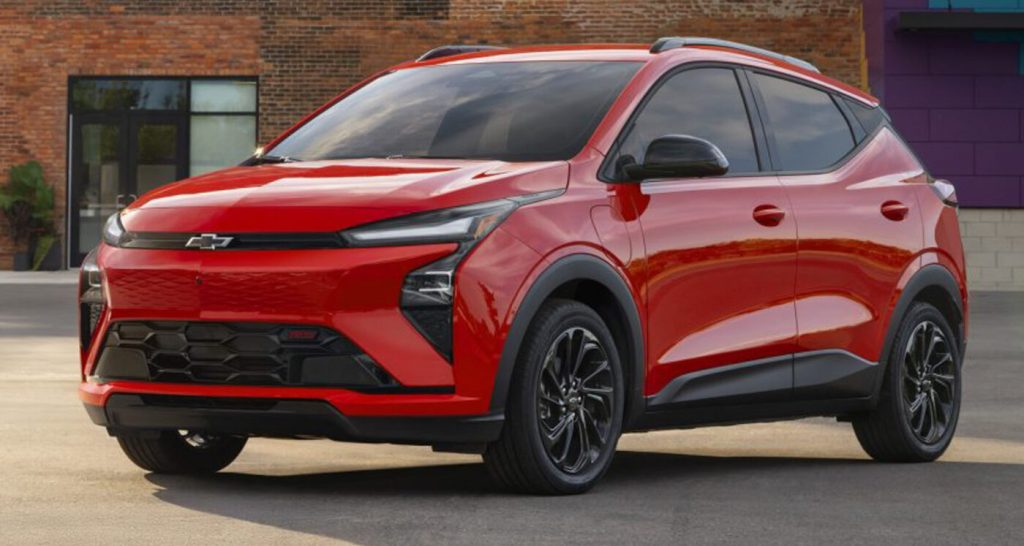
GM attributed the Bolt’s return to strong customer demand, but Trump administration policies appear to have killed the business case for it. By Stewart Burnett
Just weeks after first deliveries of the next generation Chevrolet Bolt electric vehicle (EV) began, General Motors has confirmed it will discontinue production of it in mid-2027. The stop will commence approximately 18 months after manufacturing first kicked off at the Fairfax Assembly plant in Kansas, and the factory will transition back to internal combustion engine (ICE) production.
In place of the next-generation Bolt, GM will onshore production of the Buick Envision and the Chevrolet Equinox, currently produced in China and Mexico respectively. The Bolt is fresh to the market, launching in November 2025 on a “limited run” basis with deliveries beginning in January. The EV, discontinued once previously before its 2025 reboot, was popular as an entry-level model in the US market.
When the reboot was first announced, GM attributed the Bolt’s return to strong customer demand. The automaker expected that the updated model would account for most Chevrolet EV sales during 2026. However, in the face of strong opposition to green technologies and overseas manufacturing by the Trump administration—most significantly the elimination of the US$7,500 federal EV tax credit—it appears that GM no longer sees a viable path forward for the vehicle.
The Fairfax plant currently operates on a single shift with 900 workers remaining on indefinite furlough. Moving the Envision to Kansas eliminates import duties on China-built vehicles that have added significant costs for GM, while relocating Equinox production from Mexico cushions the automaker against persistently volatile trade policies. policy volatility. The ICE-powered Equinox will arrive in 2027 with the Envision following in 2028.
The decision forms part of GM’s broader US$4bn investment programme expanding ICE pickup truck and SUV production across three US facilities. The automaker shifted its Orion Township, Michigan plant from planned EV production to traditional powertrains in 2025 despite receiving US$480m in state grants for electrification under former President Joe Biden. GM has stated that the investments will boost US assembly capacity to over two million vehicles annually, supporting its next-generation V-8 engine programme at the Tonawanda plant near Buffalo.
For GM, there is a clear rationale behind playing it safe by sticking with ICE. The company enjoyed record sales of Suburban and Tahoe models in 2025—their best performance in 18 years—while Yukon deliveries grew 22% during H1. Additionally, the Bolt cannot access federal incentives under tightened sourcing rules, weakening its business case against more profitable crossovers.
The reversal contrasts with Japanese and Korean OEM including Hyundai, Honda, Nissan and Toyota, which continue EV investment in the US albeit at slower rates than originally planned. This is somewhat ironic, given the initial hesitation these automakers broadly expressed towards EVs just a couple of years ago. Toyota will concentrate EV production at Georgetown, Kentucky while Nissan focuses on its Canton, Mississippi facility, positioning itself for both ICE and EV offerings.
E-Mobility,Manufacturing,Markets,News,OEMs,General Motors,Stewart BurnettGeneral Motors,Stewart Burnett#kills #Bolt #days #launch #ICE #pivot #ramps1769175122
More Stories
Pony.ai, CATL partner on first L4 electric light truck
UK lays regulations for automated passenger services
Leapmotor reveals China-only B05 Ultra at Beijing show