
Could a fragmented approach to powertrain deployment work in Toyota’s favour, or could it cost the automaker a competitive advantage? By Stewart Burnett
Toyota is embracing a fragmented region-based approach to its model lineup, focusing on internal combustion engine (ICE) technology and hybrids in Europe and North America, and electric vehicles (EVs) in China. The move is largely a result of uneven support for green technologies globally, and comes on top of years of scepticism about electrification from the Japanese automotive giant.
Toyota announced plans back in November to invest US$10bn over five years to boost local production of next-generation engines and components across five plants. Chairman Akio Toyoda has framed the decision around existential concerns for traditional automakers. “Automobiles, as an industrial product, are in danger of becoming commoditised,” he warned. He then expressed worry that superiority in the electric and autonomous era will hinge purely on battery performance and AI rather than traditional engineering prowess.
In December, Toyota unveiled the GR GT hybrid sports car, featuring a 4-litre V8 engine, as a statement of intent about preserving engine technology even under tightening environmental regulations. The US market is responding favourably, if not to this vehicle—which sits comfortably in the premium segment—but to this approach. Hybrids accounted for approximately 13% of new vehicle sales by powertrain during the third quarter of 2025, the highest percentage of any electrified vehicle type according to Cox Automotive.
Toyota’s redesigned RAV4 SUV became the first standard hybrid sold in the US that was no longer exported from Japan. Local production is a growing necessity in an increasingly fragmented global market; the US has imposed 15% tariffs on Japan since September 2025.
China is the world’s largest auto market, and presents a starkly different challenge for Toyota. There, the automaker’s new vehicle sales there totalled 1.77 million units during 2024, marking a third consecutive annual decline. Meanwhile, a price war instigated by BYD was underway; the Chinese EV maker implemented aggressive price cuts in the CN¥100,000 (US$14,300) sedan segment where Japanese automakers have traditionally specialised.
Regional Toyota executives have tried to turned the ship around by taking the ‘in China, for China’ approach that is increasingly common among global automakers. “In China, we will focus not on cars for the global market, but on cars made specifically for China,” one such executive told an applauding audience in Shanghai during summer 2025. “If you find our Japanese headquarters uncooperative in any way about investing in China, I will explain things to them directly.”
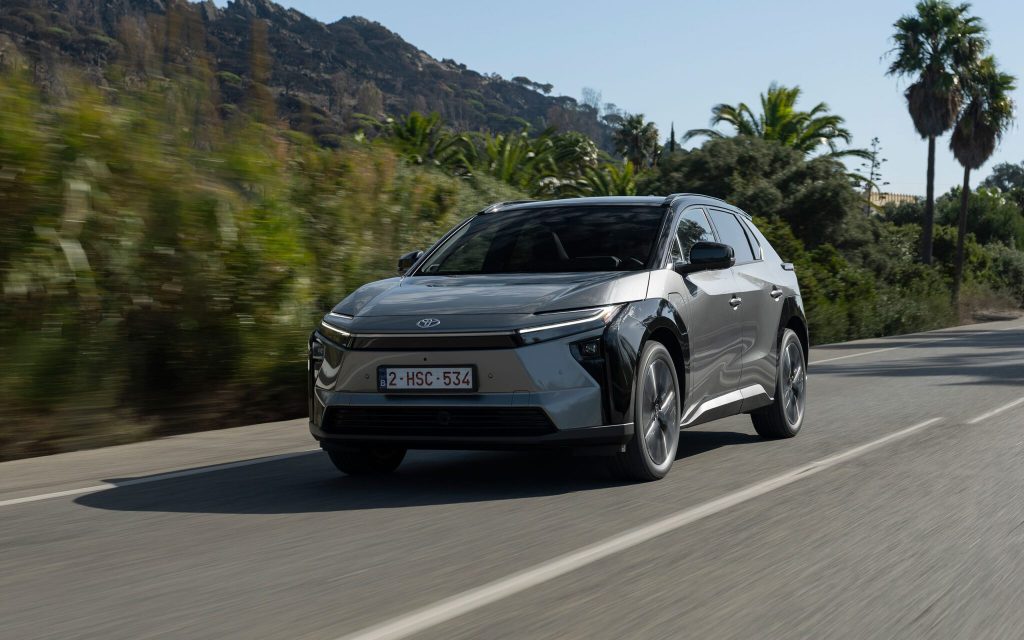
The China-specific strategy produced the bZ3X electric SUV released in March 2025, jointly developed with local joint venture partner GAC. The SUV uses less expensive Chinese LFP batteries, allowing the automaker to offer a CN¥109,800 starting price. Sales exceeded 10,000 units in November, with Toyota planning to follow up with the bZ7 e-sedan later in 2026 Meanwhile in Japan, the refreshed bZ4X claimed the top domestic EV spot during the fourth quarter with 3,448 sales—a 22-fold increase—finally overtaking Nissan after 15 year of dominance with the Leaf.
Unfortunately, maintaining multiple powertrain strategies across fragmented markets carries a substantial cost. Toyota spent ¥1.3tr (US$8.3bn) on research and development during fiscal year 2024, compared with BYD’s approximately US$7.8bn and Tesla’s US$4.5bn, raising questions about whether the automaker risks falling behind rivals pouring their resources on specific technologies. The traditionally self-reliant company has begun embracing partnerships, teaming with NTT on crash prevention AI and connected car technology while working with Waymo on autonomous driving development.
Although Toyota has historically been more cautious to embrace EVs than other global automakers, a large portion of the present ICE focus is due to the Trump administration’s policy reversals specifically targeting green industries. In addition to the elimination of the US$7,500 federal EV tax credit in September—which subsequently caused a collapse in demand—he has doubled down on fossil fuels, making no secret of his administration’s goals in Venezuela.
Chairman Akio Toyoda has been similarly upfront regarding his attempts to curry favour with the Trump administration. In November 2025 he caused significant controversy by appearing in a red cap and shirt emblazoned with President Trump’s ‘Make America Great Again’ slogan. Toyoda, noted for making large political contributions to the Republican party, fired back at critics: “I’m not here to argue whether tariffs are good or bad. Every national leader wants to protect their own auto industry. We are exploring ways to make tariffs a winner for everyone.”
News,Stewart Burnett,Toyota GroupStewart Burnett,Toyota Group#Toyota #attempts #multipowertrain #approach #global #markets1768020990
More Stories
Pony.ai, CATL partner on first L4 electric light truck
UK lays regulations for automated passenger services
Leapmotor reveals China-only B05 Ultra at Beijing show