




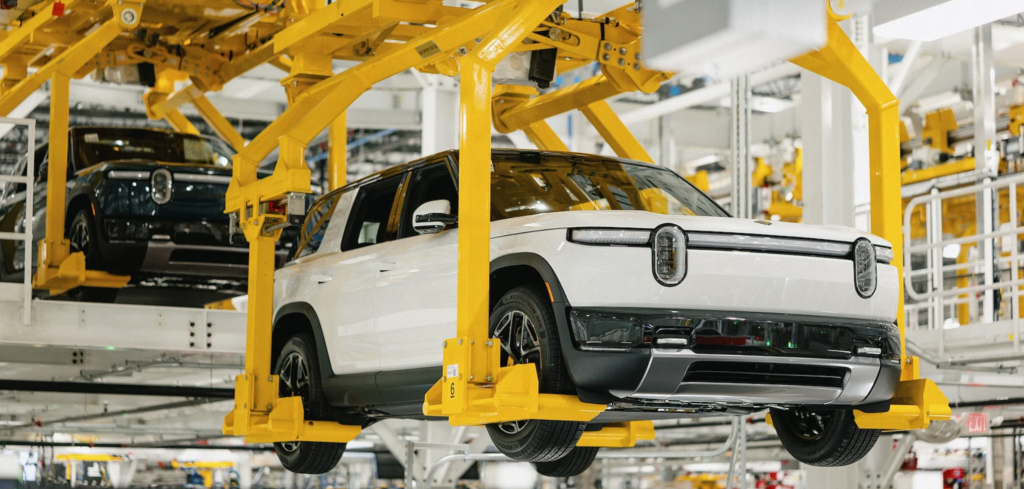
Rivian’s Georgia plant has already survived construction pauses, state court battles, and a change of administration. By Stewart Burnett
Rivian has renegotiated its Department of Energy loan for its upcoming Georgia plant from US$6.57bn down to just US$4.5bn, consolidating what had been a two-phase funding structure into a single tranche to be drawn in early 2027—a year sooner than originally scheduled. The revised terms emerged alongside first-quarter results showing revenue of US$1.38bn, up 11% year-on-year and narrowly ahead of analyst estimates.
The electric vehicle (EV) maker also reported net loss of US$416m compared with US$541m in the same period a year earlier. It is aiming for a gross operating profit for 2026, which if it bears out will mark the first year it has done so. It is highly unlikely that Rivian will enjoy its first net profit either this year or next.
The reduction to the Georgia plant’s loan size is noticeably offset by a capacity increase: its initial phase has been raised from 200,000 to 300,000 units annually, with Rivian citing greater confidence in its midsize platform as the basis for the decision. During the earnings call, Chief Financial Officer Claire McDonough said the combined output of the Georgia and Illinois facilities—515,000 units in total—represents the scale at which the company expects to reach positive free cash flow. A lower pad at the Georgia site remains undeveloped and reserved for future expansion beyond that figure.
The plant’s path to this point has been anything but straightforward. Rivian first paused Georgia construction in March 2024 to preserve cash, redirecting initial R2 production to its existing plant in Illinois. This move led many analysts at the time to believe that the plant’s construction was being abandoned, despite the company’s insistence it would proceed.
Legal challenges over Georgia’s US$1.5bn incentive package, the largest in the state’s history, occupied courts for nearly two years before being cleared by the state Supreme Court in 2023. Local opposition over groundwater and rural land also caused uncertainty over the plant’s future; the state eventually took direct ownership of the Stanton Springs site in 2022 to circumvent local zoning resistance.
The return of President Donald Trump to the White House has only added to this uncertainty. Indeed, the original US$6.57bn loan was negotiated and approved in the final weeks of the Biden administration, and Trump’s broader rollback of federal EV support—including moves to cancel or reduce Department of Energy loan commitments across the sector—left the Georgia facility’s federal backing in limbo for several months. The renegotiated US$4.5bn structure, while smaller, appears to have survived that review intact.
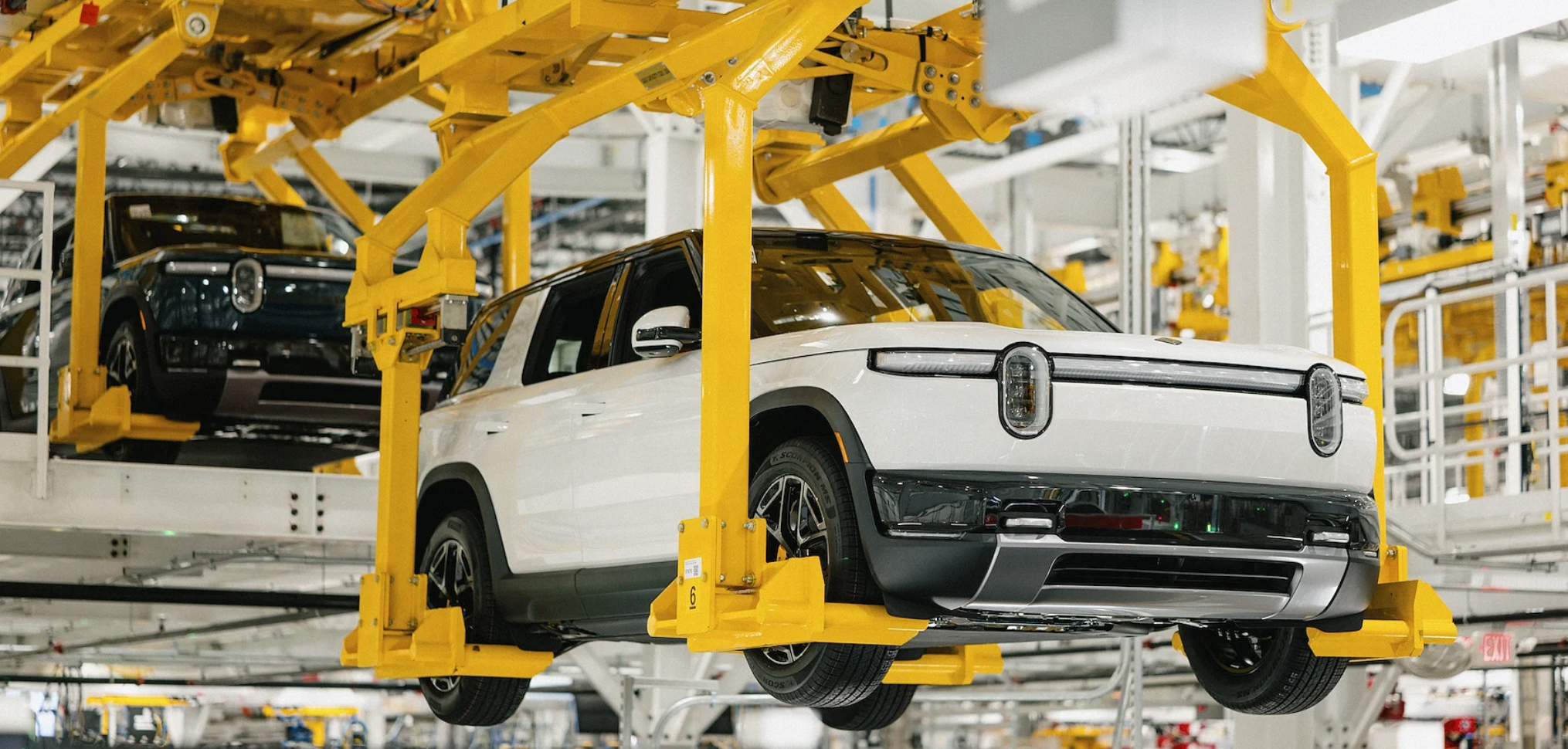
Rivian broke ground formally in September 2025 and is now in the early stages of vertical construction at the site outside Atlanta, with first vehicle production targeted for late 2028. Until then, R2 output runs through Normal, where Rivian began production in late April at an annual capacity of 155,000 units. The R2 launch variant is priced at US$57,990, with a US$45,000 trim planned for late 2027 that the company expects to materially broaden the addressable market. Launching with the higher-cost trims is intended to help bring down production costs while it works to realise better unit economics.
The automaker’s third model, the R3 light SUV, is planned for Georgia production too although there is no confirmed timeline for this. The Georgia plant will also serve Rivian’s robotaxi commitments; under a deal struck earlier , Uber in 2025will invest up to US$1.25bn in Rivian through 2031 conditional on milestone achievement, with an initial US$300m investment expected to close in the second quarter. The first tranche of the order covers 10,000 fully autonomous R2 robotaxis for deployment in San Francisco and Miami from 2028, with options for up to 40,000 additional vehicles from 2030.
Rivian’s free cash flow remains deeply negative at US$1bn in the first quarter, nearly double the prior-year figure, reflecting rising R2 pre-production costs and expanded software and cloud spending. Research and development expenditure grew 20% year-on-year to US$458m. The EV maker remains heavily dependent on capital injections from Volkswagen, with which it has a software and electronic architecture joint venture.
In its Q1 results, Rivian reaffirmed its full-year delivery guidance of 62,000 to 67,000 vehicles, with R1T and R1S models expected to account for the majority of that total while R2 deliveries build. Unfortunately, this leaves the company with quite a lot of ground to cover before it can reach the volume economics the Georgia plant is being built to facilitate.
E-Mobility,Manufacturing,Markets,News,OEMs,Software-Defined Vehicle,Stewart BurnettStewart Burnett#Rivian #Georgia #plant #loan #cut #US4.5bn #capacity #lifted1777627749



More Stories
Honda UK appoints Doyle to lead Automobile business
Nissan scraps EV plans at Mississippi plant in favour of hybrids
Hyundai registrations to drop in 2026 ahead of EV roll-out