


China’s auto industry is trying to reconcile market saturation with the need to keep factories open, so heavy discounting continues. By Stewart Burnett
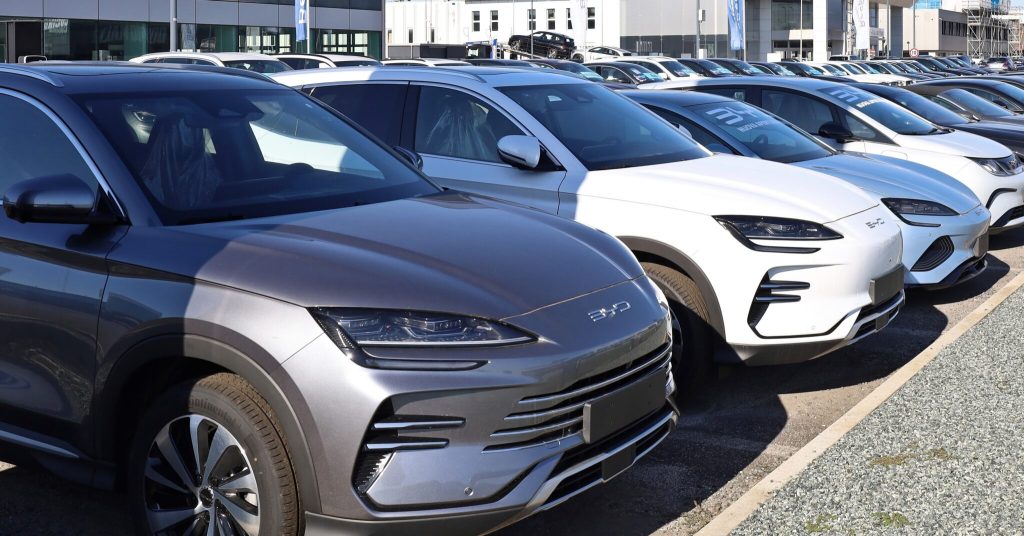
Average discounts on BYD vehicles rose to a record 10% in March 2026, according to China auto market data compiled by Bloomberg, as price warring in the world’s largest car market deepens despite repeated regulatory interventions. Discounts from rivals including Geely and Chery also edged higher, with the developments coinciding with the opening of the Beijing Auto Show—arguably the most impactful in the event’s 36-year history.
Chinese automakers are collectively reckoning with overcapacity at a scale that makes price restraint individually irrational, even when it is broadly destructive. China’s factories can produce 55.5 million vehicles annually—almost two-thirds of the 91.7 million cars sold worldwide last year. This substantially exceeds local demand, with domestic sales reaching approximately 23 million that same year. This puts average capacity utilisation at around 50%.
Government regulators have not been entirely idle as the price war waged on; executives from more than a dozen major electric vehicle (EV) makers were convened in 2025 to be warned against below-cost selling and unreasonable discounts, and they have received similar warnings at least three more times in 2026. Rules that explicitly forbid loss-making sales—that is, sales at sticker prices below the whole-cost of the vehicle—were implemented in February 2026.
The discounting has continued regardless, and the financial toll of this activity has been severe and continues to worsen. Research published by China Automobile Dealers Association member Li Yanwei calculated that the price war destroyed as much as CN¥471bn (US$69bn) in industry revenue between 2023 and 2025, as average vehicle prices fell 11% from CN¥217,000 to CN¥194,000 over three years.
BYD’s net debt-to-equity ratio has risen to 25% after spending four years in negative net debt territory, partly due to Beijing pressure forcing the automaker to abandon an IOU-based supplier payment system and shift toward interest-bearing debt. The company reported its first annual profit decline since the pandemic earlier in 2026, and Chief Executive Wang Chuanfu wrote in his shareholder letter that the industry has entered a “brutal knockout stage”.
Some signs of constraint have emerged on direct price-cutting: Tesla raised the Model Y by approximately CN¥18,000 in recent weeks, and BYD and Xiaomi have also lifted prices on a handful of specific models. The January 2026 halving of the EV purchase tax exemption—adding CN¥9,000-15,000 to the on-road cost of a mid-range vehicle—and a 130% rebound in battery-grade lithium carbonate prices since mid-2025 have reduced automakers’ room to absorb further cuts.
Citi analysts do not expect significant additional price reductions in 2026; however, there are other fronts that China’s automakers can battle on without triggering regulatory scrutiny. Zero-interest financing over five to seven years—a practice adopted by both BYD and Tesla—may not represent a direct price cut, but nevertheless offers a concession of tens of thousands of yuan. Software bundling is also an increasingly common practice, with advanced driver assistance software packages worth CN¥15,000–35,000 now offered as complimentary features by various players.
One of the more cunning methods deployed is to inflate trade-in valuations at the point-of-purchase—offering a customer CN¥50,000 for a vehicle effectively worth little more than CN¥15,000 in scrap allows some automakers to lower the price of entry without technically selling a new car at a loss.
The most permanent solution to the price war, ultimately, is for there to be less competition in the market. Roughly 130 EV brands are currently based in China, but the general consensus among analysts is that little more than a dozen will survive through the rest of the decade. More than 400 brands have already exited the market since 2018.
The central government has expressed concern that consolidation through failure could lead to long-term unemployment for many workers. Thus, local and national authorities have consistently chosen to defer through subsidies and preferential policy, even at the cost of the overcapacity those interventions perpetuate.
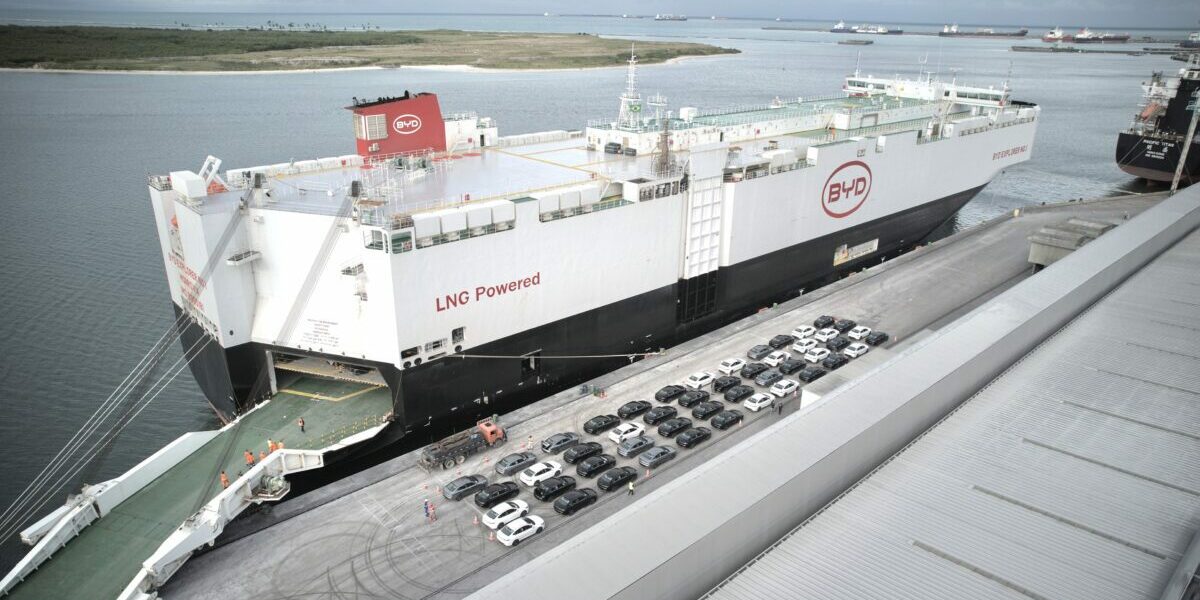
The overseas dimension of the price war is increasingly visible to foreign markets. Excess production not absorbed domestically is now being redirected to exports, which more than doubled in March to a record level. That surge has triggered tariff responses in the EU, Brazil and elsewhere, limiting the degree to which international markets can absorb Chinese surplus.
Many of China’s automakers are now explicitly treating overseas growth as a way to offset weakness in the domestic market. The approach is working to an extent: BYD raised its 2026 overseas sales target from 1.3 million sales to 1.5 million in late March. Other automakers like Chery, Great Wall and Changan are eyeing similar growth.
For the remainder of 2026, the price war will likely continue to evolve in form while remaining fundamentally unresolved in substance. Certainly, it will be restrained at the surface by regulatory pressure but sustained underneath by the dual realities of factories that cannot afford to be idled and government officials who fear a spike in unemployment.
E-Mobility,Manufacturing,Markets,News,OEMs,BYD,Stewart BurnettBYD,Stewart Burnett#Chinas #price #war #rages #BYD #sets #record #discounts1777041053


More Stories
Pony.ai, CATL partner on first L4 electric light truck
UK lays regulations for automated passenger services
Leapmotor reveals China-only B05 Ultra at Beijing show