



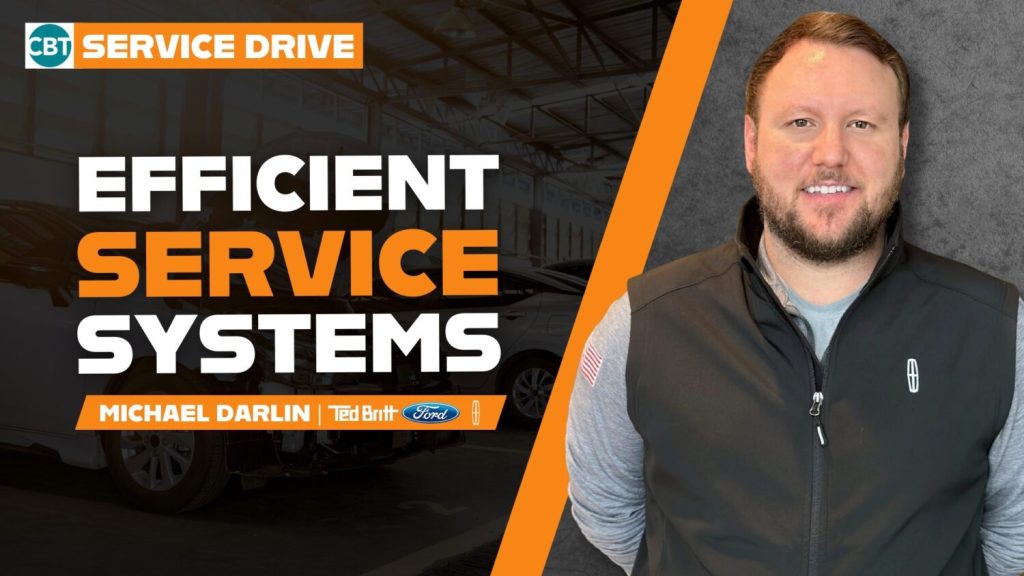
Limited space and growing service demand are prompting dealerships to rethink productivity. At Ted Britt Ford & Lincoln in Chantilly, Virginia, implementing a one-technician-per-bay structure, combined with technology-driven communication systems, has increased throughput, profitability, and customer satisfaction without expanding facilities.
Joining us on the latest episode of Service Drive is Michael Darlin, Senior Director at Ted Britt Ford and Lincoln of Chantilly, to share how dealers can improve service efficiency and customer satisfaction.
Sign up for CBT News’ Service Drive and get fixed ops news and tips delivered straight to your inbox.
According to Darlin, by limiting assignments to one bay, the dealership has seen measurable improvements in daily service hours and overall customer satisfaction. He notes that additional support in a second bay is provided only when a technician has a helper.
A key consideration in this model is addressing the technician shortage. Ted Britt tackles this by investing in apprenticeship programs, fostering internal growth, and training new technicians. This strategy ensures technicians are fully integrated into the process and has successfully resulted in staff retention throughout the implementation period.
To further reduce lost time, the dealership has leveraged technology to streamline communication among advisors, technicians, and parts staff. Time studies revealed that technicians previously spent up to two hours daily at the parts counter, representing roughly 800 lost hours per month. Integrating a communication platform has reduced these trips by more than 75%, allowing technicians to focus on repair work and increasing both throughput and profitability per bay.
Additionally, the implementation of the new system has led to considerable improvements in customer satisfaction. By introducing multipoint video inspections and a service pricing guide, the dealership has increased transparency, which has, in turn, boosted upsell opportunities. This rise in customer experience scores directly correlates with gains in efficiency, demonstrating that operational improvements yield benefits beyond financial metrics alone.
“I think internally, increasing efficiency, the result of that is going to be not only more profitability, but also an increase in customer satisfaction.”
Darlin emphasizes that success in service operations requires the creative use of existing resources, the integration of technology, and active participation by technicians. By involving staff in decision-making and optimizing workflows, dealerships can increase labor productivity and maintain high customer satisfaction levels without physical expansion.
Ted Britt Ford & Lincoln’s approach demonstrates that strategic operational changes, combined with technology and workforce development, can significantly enhance service performance, even in space-constrained facilities.
Service Drive,Fixed-Ops,Featured,Dealership Management,car business,Retail Automotive,auto industry,service department,Ted Britt Auto Group#Ted #Britt #Ford #amp #Lincoln #boosts #shop #efficiency #technician #bay #approach1773911459

More Stories
Weekly roundup: FTC wants dealers to report deceptive pricing, Ford boost U.S. assembly, Carvana expands dealership portfolio
Autonomous future back in focus as Waymo expands, Uber reinvests billions
New car sales drop 7.3% in April, but don’t blame buyers