


Big name players are backing humanoid robots, but the form factor may offer limited advantages to automotive. By Megan Lampinen
In the quest to modernise manufacturing operations and optimise efficiency, automakers and suppliers are drawing on a wide range of technologies. Sensors, 5G connectivity, digital twins and AI are quickly becoming foundational to vehicle production, supporting both human workers and robots. Robots themselves are evolving rapidly in the wake of AI advances and have been pegged as one of the most influential trends for the automotive sector in 2026.
“Robots are a physical manifestation of AI on the manufacturing floor,” observes CJ Finn, PwC US Automotive and Mobility Leader. Anything related to AI is attracting investment and headline space. McKinsey Partner Kersten Heineke describes robots and physical AI as “the hidden heartbeat of the auto industry” as “cars are no longer just assembled—they’re created in adaptive, intelligent factories.”
While this applies to all AI-powered robots, the past few months have seen particular interest in humanoids. Tesla unveiled its Optimus robot in 2021. Powered by AI, it can walk, climb stairs, and carry and manipulate objects. Chief Executive Elon Musk announced in December 2025 that sales of Optimus units to other parties would finally begin in 2026.

Where Tesla leads, others are keen to follow. CES 2026 featured a dedicated Robot Pavillion from the K-Humanoid Alliance, a coalition devoted to humanoid robot research and development. Among the automotive players, such big names as Hyundai, Nvidia, and Qualcomm are all keen to get in on the action as well. For instance, Qualcomm unveiled an end‑to‑end general‑purpose robotics architecture designed for full‑size humanoids. Both Tesla and Qualcomm have highlighted the crossover between automated driving technology and automated robots.
Analysis from Market Research Future (MRFR) estimates that the global market for humanoid robots will grow from US$40.85bn in 2025 to US$1,036bn by 2035. It’s a considerable growth trajectory, but just how impactful will they be within automotive production?
Who’s doing what?
Robots are particularly suited for areas that are deemed dangerous, dirty and repetitive. While Finn thinks automakers and suppliers will realise manufacturing advances in the short term through robotics, he adds this is “not necessarily through humanoids.”
Craig Melrose, Global Managing Partner, Mobility and Advanced Technologies at digital engineering consultancy HTEC, also anticipates growing use of robotics for complex, repeatable jobs, but more along the lines of floor or ceiling mounted units. “Everybody now is enamoured with humanoids and [the concept that] the machines are going to take over the world,” he tells Automotive World. “I just don’t see huge potential real-world applications for the humanoid form factor. It’s fantastic for CES or those types of events, but I doubt it’s going to be in factories any time soon. It will be restricted to proof of concepts and pilots, not widespread.”
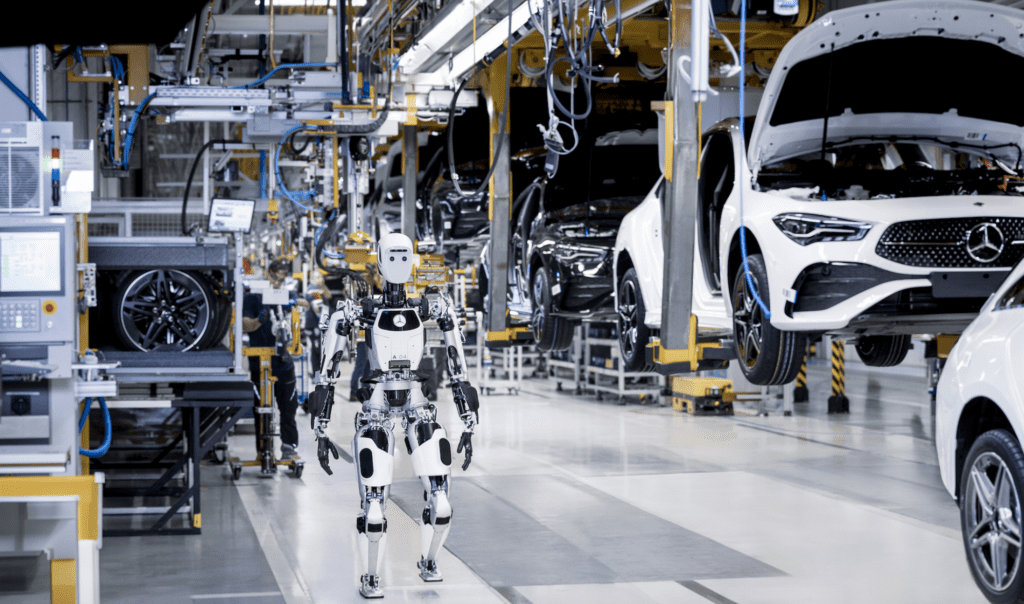
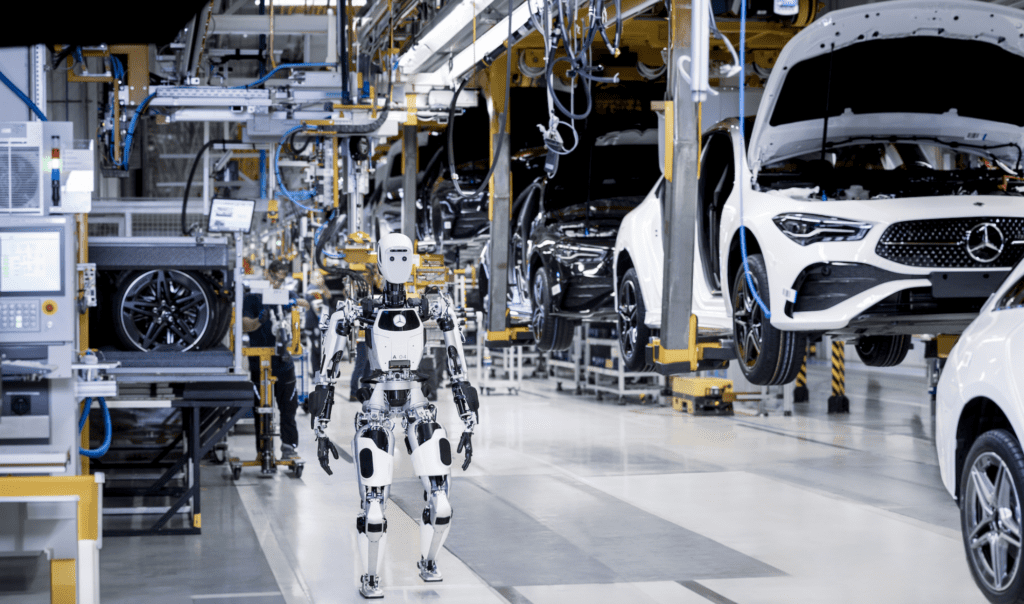
Tesla has deployed a couple of Optimus robots within its car assembly operations, while BYD has used the humanoid Walker S1 model, but applications remain limited. Mercedes-Benz signed an agreement with US robotics company Apptronik in March 2024 to develop new applications for humanoid robots in a logistics and production environment jointly. In 2025, the automaker invested an unspecified “low double-digit million-euro amount” in the partnership. While nothing has yet to materialise on the plant floor, Mercedes confirmed to Automotive World that “as part of this cooperation, a deployment of humanoid robots is planned for intra-logistic areas in production over the next few years.”
Hyundai has said it plans to introduce the humanoid robot Atlas within its car factories starting in 2028. Atlas is a product of Boston Dynamics, the company behind the robot dog Spot, adopted by the likes of Hyundai, Ford and BMW.
More hype than impact
Despite the noise around humanoids, the form factor may not have much to offer automotive manufacturing. “Think about a distribution warehouse, where you need a robot to crawl over and pick up bins,” says Mark Barrott, a Partner in Plante Moran’s Automotive & Mobility Practice. “The robot needs to be able to reach up 30 or 50 feet. Is humanoid really the right form factor?” He suggests not, though adding that the human form could be attractive primarily because it makes other workers feel more comfortable.
Then there’s the Tesla factor. “The agenda’s very much driven by Elon Musk. When Elon has a humanoid robot that he wants to sell, the agenda or the narrative is made to fit,” adds Barrott.
His colleague Doug Hockenbrocht, Partner in Plante Moran’s Information Technology Practice, voices similar scepticism. “A lot of capital is concentrated in a couple of tech firms that need to sell their technologies and chips, and they’re pushing humanoid applications. It’s possible and it’s growing, but the gap between the tech world saying they have something and the human world being ready to adopt it is always the impediment.”
Articles,Manufacturing,OEMs,Megan LampinenMegan Lampinen#Whats #humanoid #robot #hype1772444174
More Stories
Pony.ai, CATL partner on first L4 electric light truck
UK lays regulations for automated passenger services
Leapmotor reveals China-only B05 Ultra at Beijing show