



Ford is betting that “obsessing” about aerodynamics and weight is the smartest path for US automakers to reduce their EV costs. By Stewart Burnett
Ford has offered an in-depth look at the engineering behind its upcoming mid-size electric pickup, set to launch in 2027 at a starting price of around US$30,000—roughly US$20,000 below the average new vehicle transaction price in the US. The automaker says the target can be achieved through radical improvements in aerodynamic efficiency and electrical architecture, which will allow it to use a smaller battery pack while still increasing range.
The vehicle will be the first product to emerge from Ford’s Universal Electric Vehicle (EV) platform—described by the automaker as a “Model T moment” at the time of its announcement—developed by a California-based skunkworks team that has grown from a single employee to approximately 650 people split between Long Beach and Palo Alto.
That same team also plans to develop a range of crossover and sedan variants over an undisclosed timeline, with the Louisville, Kentucky plant currently being retooled to accommodate the entirely new production system. All vehicles are targeting affordability, although the target price of the 2027 pickup is the only pricing-related information currently available.
Central to Ford’s cost argument is the battery. Accounting for around 40% of a typical EV’s total cost and up to 25% of its weight, the pack has historically been enlarged to address range anxiety — an approach Ford is explicitly rejecting with the new platform. Instead, it uses a structural lithium-iron-phosphate battery assembled at Ford’s BlueOval plant in Marshall, Michigan, integrating the pack into the truck’s body to eliminate redundant framing components while keeping chemistry costs low.

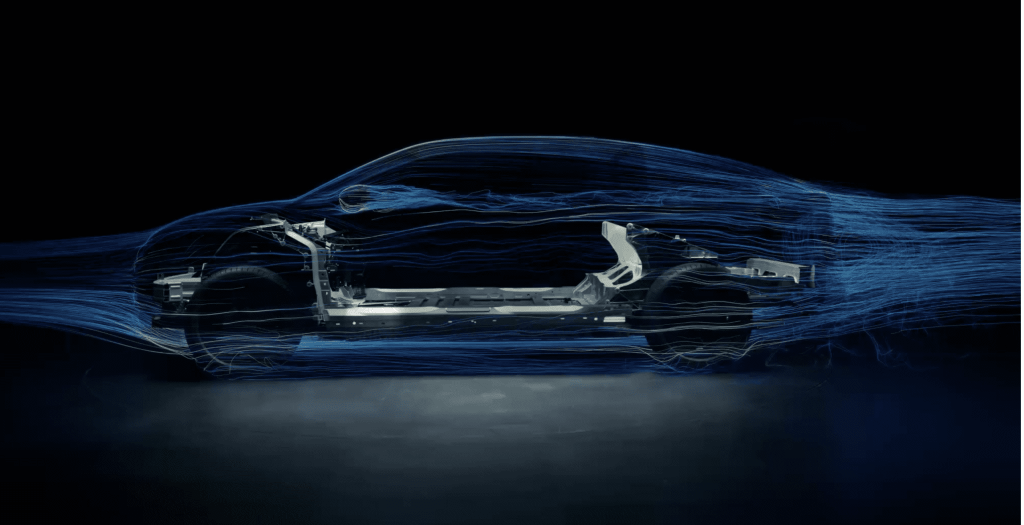
Aerodynamics is the other major lever at Ford’s disposal. Ford claims its pickup is more than 15% more aerodynamic than any other model currently on sale, a figure that translates into nearly 50 additional miles of range despite a smaller pack. More than half of the aerodynamics team came from Formula One, bringing with them what Ford Executive Director of advanced EV development Alan Clarke—who penned the deep dive—describes as a “bounty culture”. This framework, he noted, converts every engineering trade-off into a direct battery cost or range value.
“The aerodynamics team and interior team share the same goal, and both understood that adding even 1 mm to the roof height would mean US$1.30 in additional battery cost or 0.055 miles of range,” Clarke explained. “With bounties, each team has a common objective to maximise range while decreasing battery cost.” Among the results of this approach: side mirrors 20% smaller than conventional units, saving mass and adding 1.5 miles of range; and an underbody treatment that alone contributes 4.5 additional miles.
The platform also consolidates the vehicle’s electronic architecture from around 30 scattered control units down to five main modules, shortening the wire harness by 4,000 feet and reducing its weight by 22 pounds compared to Ford’s first-generation EVs. Ford developed the charging ecosystem and software in-house following its 2023 acquisition of power electronics firm Auto Motive Power, enabling bi-directional charging capability and the company’s first 48-volt low-voltage system. Parts count across the platform is 20% lower than is typical for Ford, and the truck also requires 40% fewer assembly workstations.
“Our big bet for EVs? Obsessing over the vehicle as a system to get more miles out of a smaller battery and radically simplifying the system to reduce the number of parts,” Clarke said. Ford also indicated plans to introduce SAE Level 3 autonomous driving capabilities on the new EV line by 2028.
With BYD now accounting for seven out of every ten electrified vehicles sold in Mexico and Chinese manufacturers edging closer to the US market, the company has framed the programme as a direct competitive response. Chief Executive Jim Farley—arguably the executive most fixated on Chinese competition at any Western automaker—has described the project as among the most important in Ford’s history.
E-Mobility,Manufacturing,News,OEMs,Ford Motor Company,Stewart BurnettFord Motor Company,Stewart Burnett#Fords #platform #efficiency #battery #size1771426916

More Stories
Pony.ai, CATL partner on first L4 electric light truck
UK lays regulations for automated passenger services
Leapmotor reveals China-only B05 Ultra at Beijing show