


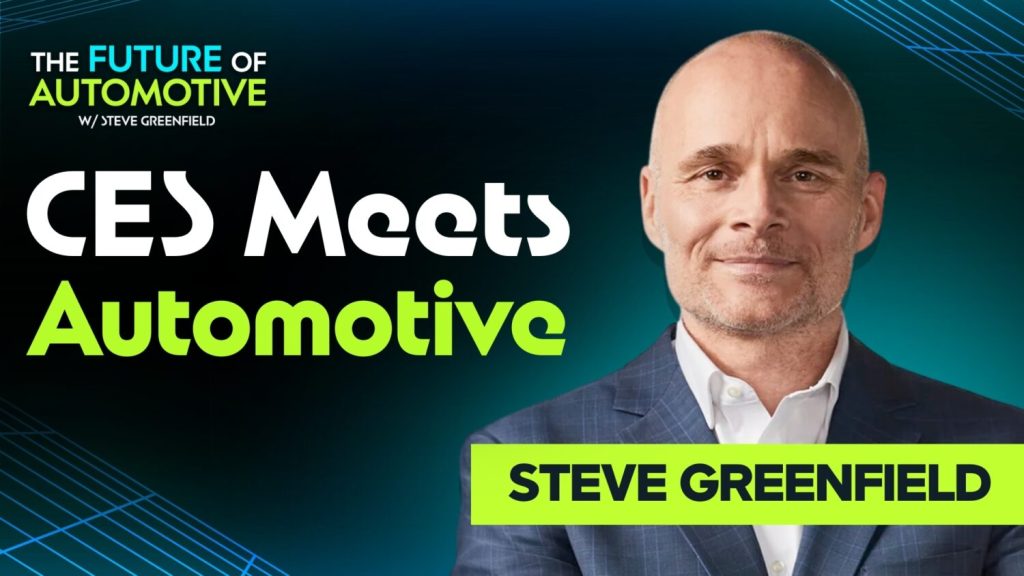
Welcome back to the latest episode of “The Future of Automotive” on CBT News, where we put recent automotive and mobility news into the context of the broader themes impacting the industry.
I’m Steve Greenfield from Automotive Ventures, and I’m glad that you could join us this week.
I am out at CES in Las Vegas this week, and it’s been an amazing few days immersed in automotive and mobility technologies.
CES was formerly the Consumer Electronics Show. The rebranding a few years ago was in response to the show growing beyond simply exhibiting new and innovative consumer-facing electronics. In fact, if anything, it’s become more of an automotive show than anything at this point.
CES is an annual Las Vegas trade show organized by the Consumer Technology Association (CTA).
The first CES was actually held in June 1967 in New York City.
In 1998, the show changed to a once-a-year format, with Las Vegas as the location. In Las Vegas, the show is one of the largest trade shows in Las Vegas.
To put the size of CES in perspective, you’ve got 140k attendees over the course of the week. The show is actually so big that it not only fills all of the halls of the Las Vegas Convention Center, but actually spills into surrounding hotels.
For example, one of the most exciting areas to visit at CES is the basement of the Venetian Hotel, which hosts thousands of Startups from around the world. It’s almost overwhelming to try to walk the floor of the Venetian and take it all in.
Sign up for CBT News’ daily newsletter and get the latest industry stories delivered straight to your inbox.
As you can imagine, at this year’s CES there was a lot of buzz around AI and humanoid robotics.
The most shocking observation is the lack of automakers at this year’s show.
In fact, we have more Chinese automakers exhibiting in the new West Hall than we do legacy automakers.
Even more telling: the largest booth in the West Hall is Hyundai Motor Group. But they aren’t exhibiting any vehicles. Everything in their booth is around robotics and industrial automation.
Post-pandemic, traditional automakers are largely shifting away from big vehicle debuts and refocusing their CES efforts on detailing the cutting-edge technologies inside and around their cars, like infotainment, autonomous driving and smart infrastructure.
This shift has opened up new space (figuratively and literally) at the show for automotive outsiders, startups and mobility newcomers to thrive, and I’ve seen CES trending over the last five years toward exciting innovations in automotive artificial intelligence, EV startups, new robotics and air mobility concepts.
The Sony/Honda joint initiative once again exhibited their Afeela vehicle, and introduced a new SUV (in addition to the sedan we’ve seen over the last four years). Sony/Honda Mobility announced that their first vehicle rolled off the production line this week, with the intention of selling directly to consumers and bypassing the Honda dealer network. I’m certain this will once again be a point of friction with the Honda dealers as they gather back here in Las Vegas next month.
I think the timing is all wrong for this vehicle. With a price point of over $90k for an EV, the frankly uninspired Afeela is going to have a very hard time getting traction with consumers in the U.S. For launch, it will only be available in California.
The other big mobility theme out here at CES this year is Autonomy, whose time, it appears, has finally come.
In the West Hall, there are three notable Robotaxi companies to watch, all three of whom have very different go-to-market strategies.
First up, Tensor Auto, whose large display you can’t miss as you first enter the West Hall.
Tensor is an American AI company dedicated to building agentic products that empower individual consumers. Their flagship product, the Tensor Robocar, claims to be the world’s first personal Robocar and the first AI agentic vehicle—fully autonomous, automotive-grade, and built for private ownership at scale.
Tensor was birthed from AutoX, a Chinese-American company founded in 2016 that gained recognition for its robotaxi services in China. AutoX deployed over 1,000 robotaxis in Shenzhen’s suburbs, earning a reputation for robust autonomous technology. However, Tensor wound down all its Chinese operations, with all offices closed and operations shut down. The AutoX brand and its China operations have been fully discontinued.
Tensor represents a strategic pivot, rebranding AutoX’s expertise to focus on personal robocars for global markets. It’s now positioning itself as a Silicon Valley-based startup that plans to be the first company to sell “a true robocar.” While AutoX operated in China’s ride-hailing ecosystem, Tensor targets individual buyers in the U.S., Europe, and UAE, leveraging a decade of AV experience to craft a vehicle that prioritizes ownership over shared mobility.
The Tensor Robocar’s sensor suite is a technological wonder, featuring over 100 integrated sensors to ensure precise navigation and safety. This includes 37 high-resolution cameras, 5 lidar units, 11 radars, 22 microphones, and 10 ultrasonic sensors, complemented by 16 collision detectors, 8 water-level detectors, and a smoke detector.
Unlike Tesla’s vision-only approach, which relies solely on cameras, Tensor’s multi-sensor strategy emphasizes redundancy and robustness, enabling the robocar to detect obstacles, pedestrians, and road conditions in challenging environments like fog or heavy rain. The inclusion of microphones allows for voice command recognition and external sound analysis, while water-level detectors ensure safe navigation during floods. The sensor suite positions Tensor’s robocar as one of the most perceptive autonomous vehicles ever designed.
Next up, Waymo is currently in discussions to raise more than $15 billion in a new funding round, valuing it at as high as $110 billion. Such funds would be more than double Waymo’s last round, which closed in October 2024 at a $45 billion valuation.
The company leads the robotaxi race with plans to expand in more than a dozen more markets in 2026. Waymo conducted 14m rides in 2026.
Waymo has recently announced international expansion into both Tokyo and London.
Waymo’s fleet composition underwent significant changes in 2025. The Jaguar I-PACE received its final delivery in early 2025 after Jaguar discontinued the model. However, Waymo is retrofitting more than 2,000 additional I-PACE vehicles from existing inventory through 2026 at the new Magna facility in Mesa, Arizona, bringing the total Jaguar fleet from approximately 1,500 to over 3,500 vehicles by 2026.
Two new vehicle platforms entered testing in 2025. The Zeekr RT, a purpose-built robotaxi developed with Geely, entered mass production with an announcement at CES in January 2025. Vehicles have been spotted testing in several markets. The Hyundai IONIQ 5 began on-road testing in late 2025 after the partnership was announced in October 2024. Both vehicles represent significant cost reductions compared to the Jaguar I-PACE.
The Magna partnership announced May 5, 2025, provides the manufacturing infrastructure for this expansion. The new 239,000 square-foot facility in Mesa, Arizona converts both Jaguar I-PACE and Zeekr RT vehicles into robotaxis equipped with the 6th-generation Waymo Driver. At full operation, the facility has capacity to produce tens of thousands of vehicles annually. Vehicles can enter service within 30 minutes of leaving the factory, dramatically reducing the deployment timeline.
In terms of Waymo’s technology evolution, the 6th Generation Waymo Driver, announced in August 2024 and deployed throughout 2025, enables this fleet expansion. The system uses 13 cameras (down from 29), 4 lidar sensors (down from 5), 6 radar units, and external audio receivers to provide 360-degree overlapping view up to 500 meters. Waymo states this generation has “significantly reduced cost” while maintaining safety performance and can reach driverless deployment “in about half the time” of previous generations. This cost reduction and deployment speed improvement makes the aggressive 2026 expansion economically viable.
Last but definitely not least is the present that Amazon’s Waymo has in the West Hall.
Amazon acquired Zoox for about $1.2 to $1.3 billion in 2020, but has continued to invest significant capital since, with some reports suggesting well over $100 million more to boost production and talent, with estimates suggesting total investment could reach many billions to realize its full autonomous vision.
In California (SFO), Zoox is operating under a pilot program rather than full commercial deployment, and it hasn’t yet secured the regulatory approvals needed to charge fares across the state.
Zoox is aiming to begin offering rides to the public “quite soon,” expand its operating regions and “significantly” grow its self-driving vehicle fleet from the couple dozen it currently operates in 2025.
For anyone that really enjoys getting a sneak peek into the future of cutting-edge technologies, I highly suggest attending the CES conference in Las Vegas, which is always held early in January each year.
So, with that, let’s transition to Our Companies to Watch.
Every week we highlight interesting companies in the automotive technology space to keep an eye on. If you read my weekly Intel Report, we showcase a company to watch, and take the opportunity here on this segment each week to share that company with you.
Today, our new company to watch is LoanBridge.
LoanBridge’s new Voice AI product gives recovery teams what they’ve never had before: instant, automated follow-up the moment a VIN alert hits.
No manual calling. No call centers. Just verified answers delivered in minutes — so you can recover faster, pay less in storage, and never lose time waiting for someone to pick up.
Other features include:
- Tow yard calls made for you, automatically
- Verified impound status in minutes
- Call center performance without call center costs
- Recover vehicles before they move
- And, they handle one VIN or 10,000 — instantly
If you’d like to learn more about LoanBridge, you can check them out at www.LoanBridge.ai.
So that’s it for this week’s Future of Automotive segment.
If you’re an AutoTech entrepreneur working on a solution that helps car dealerships, we want to hear from you. We are actively investing out of our DealerFund.
Don’t forget to check out my book, “The Future of Automotive Retail”, which is available on Amazon.com.
My second book, “The Future of Mobility,” is finally being printed! I will have copies with me at NADA at the end of the month!
Thanks (as always) for your ongoing support and for tuning into CBT News for this week’s Future of Automotive segment. We’ll see you next week!
Future of Automotive,Featured,robotaxis,artificial intelligence,Steve Greenfield,Automotive Ventures,robotics,Consumer Electronics Show#Autonomy #dominate #CES #traditional #automakers #fade1768020365
More Stories
Weekly roundup: FTC wants dealers to report deceptive pricing, Ford boost U.S. assembly, Carvana expands dealership portfolio
Autonomous future back in focus as Waymo expands, Uber reinvests billions
New car sales drop 7.3% in April, but don’t blame buyers